
EMF Meters In Paranormal Investigation: What They Actually Detect
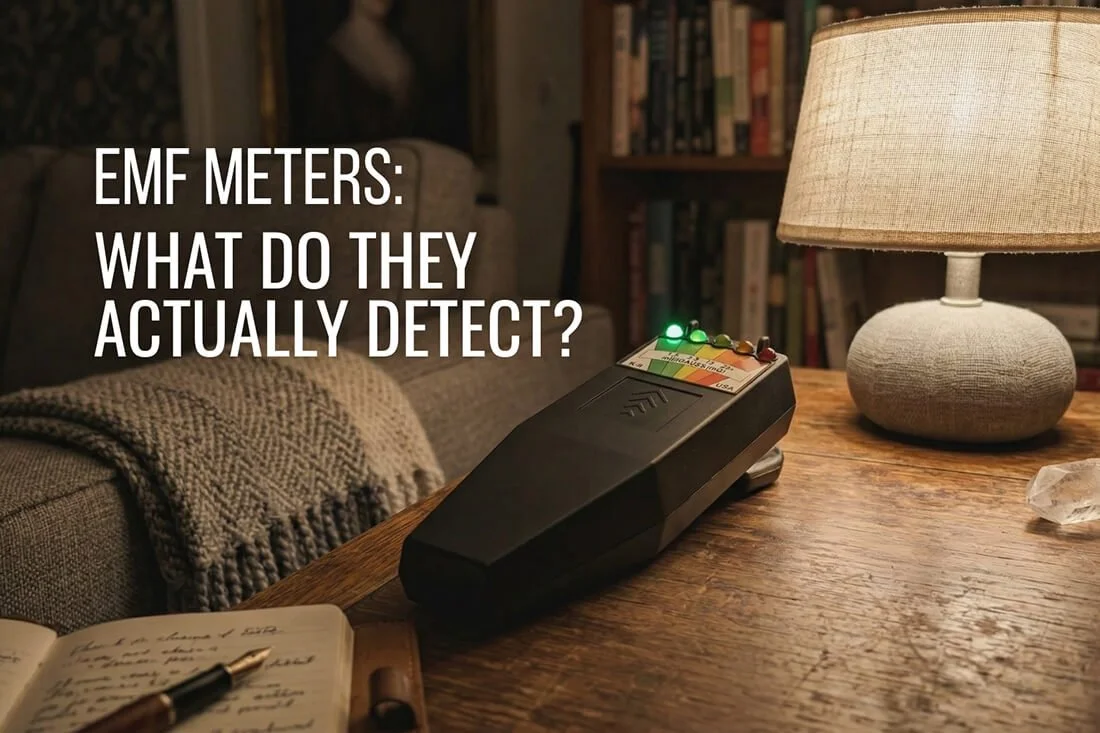
If you have watched any paranormal television programme in the last twenty years, you have almost certainly seen an EMF meter. It is the device with the row of coloured lights that flickers from green to red while someone in the dark whispers about a presence. It has become one of the most recognisable symbols of ghost hunting.
But here is the thing: EMF meters were not designed for paranormal investigation. They were built for electricians. And the gap between what these devices actually measure and what they are often presented as doing on screen is worth understanding, whether you are thinking about buying one yourself or you just want to know what is going on when an investigation team brings one into your home.
At KASE, we use EMF meters on every investigation. We also think the paranormal field has done a poor job of explaining what they can and cannot do. This post is our attempt to be honest about that.
What an EMF Meter Actually Measures
An EMF meter detects fluctuations in electromagnetic fields. That is it. Specifically, the models most commonly used in paranormal investigation detect alternating current (AC) electromagnetic fields, which are the type produced by mains wiring, appliances, and anything that runs on electricity.
They do not detect direct current (DC) fields, which are produced by the Earth itself and by permanent magnets. For those, you would need a magnetometer or a Gauss meter. Most paranormal investigators are not carrying those.
The unit of measurement is typically milliGauss (mG). A reading of 0.0 to 1.5 mG is considered a normal background level in most environments. Anything above that usually has an identifiable electrical source: wiring in the walls, a fridge compressor, a phone charger, a router, or overhead cables.
When we walk into a property with an EMF meter, we are mapping the electromagnetic environment. We are looking for what is normal, what is elevated, and where the sources are. That baseline is essential, because without it, a spike in one room means nothing.
How EMF Meters Ended Up in Paranormal Investigation
The theory, which has circulated in the paranormal community since the 1980s and 1990s, is that spirits or entities may produce or manipulate electromagnetic fields. If that is the case, then a device that detects changes in those fields could, in theory, register something when paranormal activity is occurring.
It is an interesting hypothesis. It is not a proven one.
The link between EMF detection and ghost hunting became mainstream largely through television. Shows popularised the K2 meter in particular, a simple five-LED device originally sold for checking household electrical safety. Its coloured lights looked dramatic on camera, and it quickly became the default ghost hunting tool for a generation of viewers and investigators.
What those shows rarely explained is that the K2 meter is a single-axis detector, meaning it only picks up fields in one direction. Tilt it slightly and the reading changes. Walk past a wire in the wall and it spikes. Receive a text message on a phone in your pocket and the lights go red. These are not paranormal events. They are the device doing exactly what it was designed to do.
What Causes False Readings
This is the part that does not get enough attention. EMF meters are sensitive, and in a typical UK home, there are dozens of sources that will trigger a reading. Understanding these is essential if you want to use an EMF meter with any credibility.
Common sources of EMF spikes include mains wiring running through walls, ceilings, and floors, especially in older properties where wiring may be unshielded or poorly routed. Consumer electronics such as televisions, routers, baby monitors, and smart speakers all produce measurable fields. Central heating systems, particularly boilers and thermostats, generate fluctuations when they cycle on and off. Mobile phones produce significant spikes, especially during calls, notifications, or when searching for signal. Even the meter itself can be affected by the battery it runs on or by the proximity of another electronic device in the investigator's kit bag.
On location investigations, additional sources include security systems, CCTV cameras, industrial wiring, railway lines, overhead power cables, and underground electrical infrastructure.
If an investigator does not account for all of these before interpreting a reading as unusual, the reading is meaningless.
How We Use EMF Meters at KASE
Our approach is to treat the EMF meter as an environmental monitoring tool rather than a ghost detector. Here is what that looks like in practice.
Before we begin any active investigation, we carry out a full baseline sweep of the property. This means walking every room and noting where readings are elevated and what the likely source is. We check near sockets, light switches, fuse boxes, appliances, and exterior walls where cables may run. We note the readings on a plan of the property so we can refer back to it. We repeat this process two more times over the course of the night, as we need to be able to make sure we take readings at different times to confirm our baseline, and to account for changes in pressure, atmosphere and the general busyness of a location.
Once we have a baseline, we know what is normal for that building. If we later record a reading in a location where there was no elevated EMF during the baseline, and we can rule out newly introduced electrical sources, that becomes something worth noting.
We say "worth noting," not "proof of a haunting." A single unexplained EMF spike is interesting, but it is not evidence of anything specific. It becomes more significant when it coincides with other reported or recorded phenomena, such as temperature changes, audio anomalies picked up during EVP sessions, or reports from the client about activity in that area.
Context matters more than any individual reading.
The Link Between High EMF and Feeling Uneasy
Evidence note: UKHSA and the World Health Organization say ordinary public exposure is typically well below guideline levels, and current evidence does not support a causal link between low-level EMF and symptoms such as anxiety, nausea or feeling watched. During an investigation, an EMF reading can help locate electrical sources; it is not a medical diagnosis or evidence of paranormal activity.
Official sources: UKHSA electromagnetic fields guidance: https://www.gov.uk/government/publications/electromagnetic-fields/electromagnetic-fields-sources-and-health-effects and WHO electromagnetic fields Q&A: https://www.who.int/news-room/questions-and-answers/item/radiation-electromagnetic-fields
There is one aspect of EMF that is directly relevant to homeowners and that has nothing to do with the paranormal: the effect of high electromagnetic fields on people.
Research going back to the work of Michael Persinger in the 1980s and 1990s explored whether exposure to elevated electromagnetic fields could produce symptoms including feelings of unease, anxiety, the sensation of being watched, dizziness, nausea, and even visual disturbances. The idea was that some reported hauntings might actually be caused by high EMF from faulty wiring or poorly shielded electrical systems, rather than by anything supernatural. It is worth noting that not everyone is equally affected. Research suggests that sensitivity to elevated EMF varies significantly from person to person, and most people will not notice any symptoms at all. But for those who are susceptible, the effects can be real enough to disrupt sleep, concentration, and general comfort in their own home.
This is something we actively check for during investigations. If a room where the homeowner feels uncomfortable or anxious also happens to have abnormally high EMF readings from a nearby fuse box, unshielded wiring, or an old appliance, that is a finding we report. It does not mean the place is or isn’t haunted. It means there is a potential environmental explanation that is worth addressing.
In some cases, we have found that the area of a home where people report the most discomfort corresponds to the area with the highest EMF levels from identifiable electrical sources. That is genuinely useful information for the homeowner, regardless of whether anything paranormal is happening.
If you have been feeling watched in your own home and are not sure why, a high EMF environment is one of the first things worth investigating.
What About More Advanced Devices?
Beyond the basic K2 and similar single-axis meters, there are more sophisticated tools used in the field. Tri-axis meters detect electromagnetic fields from all directions simultaneously, which removes the problem of orientation affecting the reading. The Mel Meter, developed by electrical engineer Gary Galka, combines EMF detection with ambient temperature measurement and has become widely used in investigations.
Multi-sensor devices like the EDI+ go further still, logging EMF alongside temperature, humidity, vibration, and barometric pressure. They export data as spreadsheet files, which allows investigators to review readings over time rather than relying on what they happened to see on screen in the moment.
At KASE, we prefer tools that log data because they allow us to compare readings across an entire investigation rather than relying on a snapshot. They also make it possible to correlate an EMF anomaly with other environmental changes that were happening at the same time, which is far more useful than watching lights blink.
We also use REM pods, which work differently from standard EMF meters. Instead of passively detecting ambient fields, a REM pod generates its own small electromagnetic field and alerts when something enters or disrupts that field. They are useful for monitoring a fixed area, but they are also sensitive to drafts, vibration, and temperature changes, so they need careful placement and interpretation.
Should You Buy One?
If you are experiencing something at home and want to investigate it yourself, an EMF meter is not a bad tool to have. But it is only useful if you understand what it is actually measuring.
A basic K2 meter costs around fifteen to twenty pounds and will give you a general indication of where the electromagnetic activity is highest in your home. If you find that the room where you feel most unsettled also has elevated readings near the wiring or a fuse box, that is worth knowing. An electrician can check whether your wiring is properly earthed and shielded.
What we would not recommend is treating the meter as a ghost detector. Flashing lights are not evidence. A spike next to a plug socket is not paranormal. And walking around your house in the dark watching the LEDs is more likely to increase your anxiety than resolve it.
If you want to document what is happening in your home in a structured way, our guide on what to do if you think your house is haunted is a better starting point.
Honest Conclusions
EMF meters are a legitimate part of the investigator's toolkit, but they are not what paranormal television has made them out to be. They do not detect ghosts. They detect electromagnetic fields. The skill lies in understanding what those fields mean in context, ruling out the obvious sources, and then assessing whether anything unusual remains.
At KASE, we will never point a meter at a wall, watch it spike, and tell you your house is haunted. What we will do is map the electromagnetic environment of your property, identify sources that might be contributing to how you feel in certain areas, and note any readings that we cannot explain.
That is the difference between investigation and entertainment.
Thinking About Getting In Touch?
If you are experiencing something at home and want a team that will be honest with you about what they find, including the boring explanations, you can get in touch with us here:
Use a short contact form to describe what you are experiencing in your own words:
https://www.kaseparanormal.co.uk/contact-usRequest a free chat about your situation in the contact form
Contact us via email: info@kaseparanormal.co.uk
Find us on social media:
You can also read other articles on our blog if you want to think things over before deciding what to do next: https://www.kaseparanormal.co.uk/blog