
Krampus And The Darker Side Of Christmas Folklore
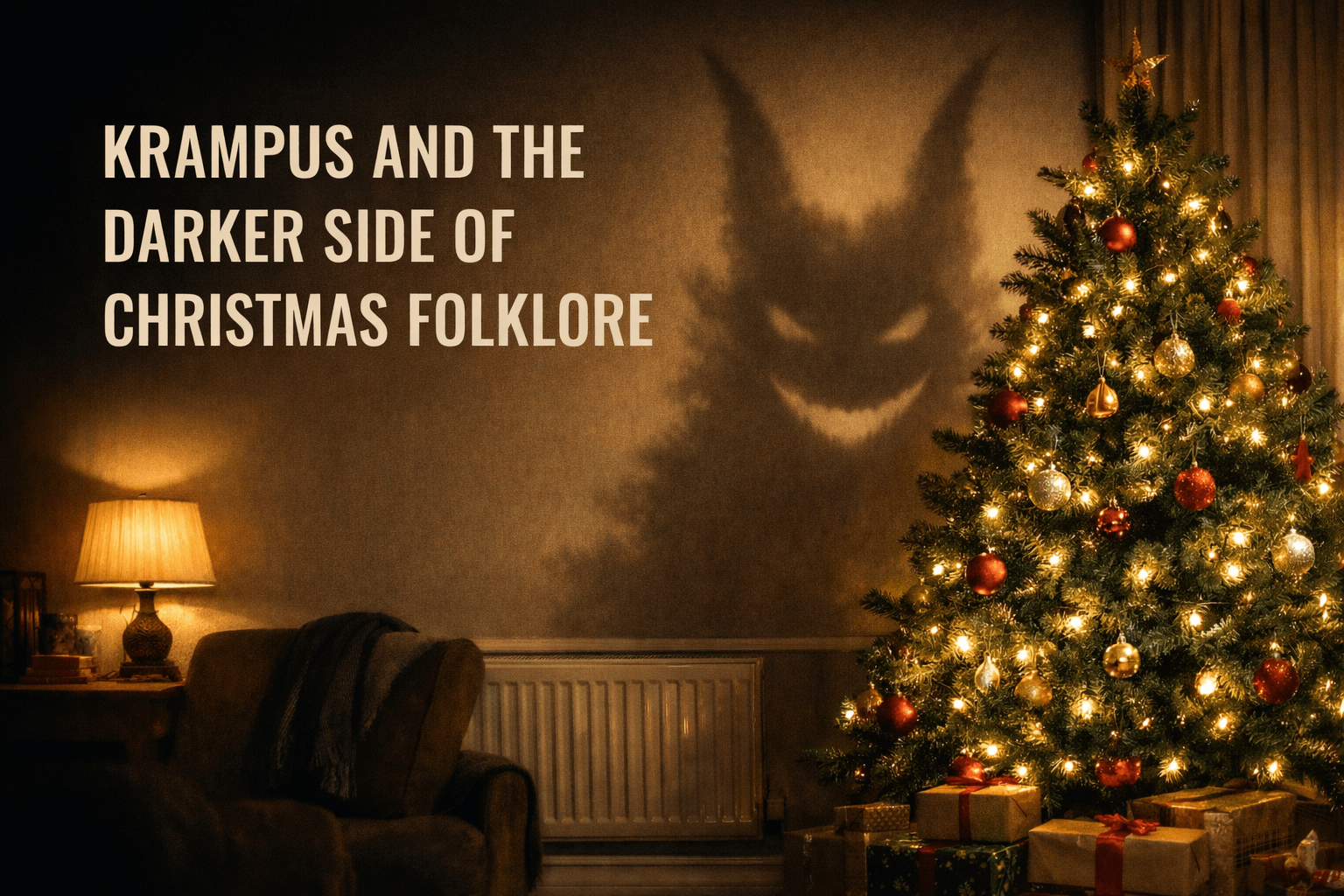
If you’ve spent any time online in December, you’ve probably met krampus. Horns, bells, fur, carved masks, and that unmistakable “hang on…” energy that sits oddly well next to fairy lights and mulled wine. He turns up in films, memes, Christmas markets, and decorations that look like they’ve escaped from a folk museum via a horror poster.
In practice, he belongs to a Central European seasonal tradition, and it makes more sense when you treat him like winter folklore rather than a literal headline. Darker characters show up in the same part of the year for a reason: midwinter is stressful, routines wobble, tempers shorten, and communities have always told stories that make the season feel structured and explainable.
If winter stories are making your home feel “off” and you want a calm, sensible chat, you can contact us here:
What Krampus Is (and isn’t)
Krampus is a winter folklore figure most strongly associated with Alpine and Central European regions, particularly Austria and southern Germany, with close links across neighbouring areas. He often appears alongside St Nicholas in seasonal customs where one figure rewards and the other represents consequences and correction.
What matters is the role he plays. He’s a cautionary character used to dramatise boundaries at a time of year when households are stretched, children are excitable, and everyone is tired. In many places, he’s expressed through public performance: carved masks, bells, fur costumes, and organised group events that are as much community ritual as spectacle.
You’ll also see the phrase krampus christmas demon used online as shorthand. It’s catchy, but it flattens the tradition into a modern horror label. In most contexts, people are pointing to a seasonal companion figure tied to St Nicholas customs and behaviour stories, rather than making a literal theological claim.
He also isn’t one neat “official” character with a single agreed script. Folklore changes by region and era. Even the look varies depending on local mask-making styles, the influence of postcards and film, and what modern audiences find visually striking. That messiness is normal. It’s why the tradition can survive outside museums and still feel current.
Where the Krampus story came from
The story sits within the St Nicholas season, centred around 6 December (St Nicholas Day). In several Central European traditions, St Nicholas is accompanied by a companion figure who carries the warning side of the moral lesson. The details shift by location, but the structure is familiar: reward and consequence, praise and correction, generosity and limits.
One of the best-known modern expressions is Krampusnacht, commonly observed on 5 December in places where the tradition is actively kept. In real terms, it tends to look like organised public ritual: costumed groups, bells, masks, and a lot of noise. It can be rowdy, but it’s still linked to a seasonal calendar rather than being treated as a separate “belief system”.
Historically, winter procession customs often blend local practice, church calendars, and the realities of communal life. In small communities, stories weren’t only entertainment. They reinforced shared expectations at the hardest time of year, when resources were tighter and patience wore thin. A warning figure works as social shorthand because it’s immediate and memorable.
Over time, the tradition adapted. Some areas formalised groups and codes of conduct. Others softened the edge. Some treated it as heritage performance. In the modern era, the imagery has also been shaped by postcards, cinema, and the internet. That’s why the “global” version can look darker and more monster-like than what many local communities would describe as the heart of the custom.
Why winter folklore gets darker in December
December has a particular mix of pressure and atmosphere. Darkness arrives early. Routines change. Social obligations pile up. Money can feel tighter. People are tired, children are wired, and houses feel smaller when everyone is inside more often. In that setting, simple cautionary stories do a lot of work.
Seasonal warning figures are, at their core, about boundaries. They make rules feel concrete. Instead of endless negotiation, the story offers a straightforward social script: good behaviour is noticed; poor behaviour has consequences. It’s blunt, but it’s memorable, which is partly why it survives.
There’s also a grounded human reason these stories feel stronger in winter. Low light reduces certainty, which makes the brain fill in gaps. Stress raises vigilance. Poor sleep lowers resilience. Put those together and the “something’s not right” feeling becomes easier to trigger, especially in quiet homes where ordinary winter noises stand out.
Folklore can help by giving unease a safe container. It turns dread into narrative, which can make it manageable. It becomes unhelpful when it feeds rumination, especially when paired with late-night scrolling and a mind already running hot. If you notice you’re getting wound up by it, the fix is often practical: better sleep, less spooky content late at night, and a bit more daylight and routine where you can get it.
European Christmas monsters and dark Christmas creatures
Krampus sits alongside a wider cluster of european christmas monsters and seasonal warning figures. They aren’t identical, but they share themes: judgement, order, and a reminder that winter has rules.
A useful comparison is Perchta (or Berchta), a winter figure associated with the Twelve Days of Christmas in some German-speaking regions. In certain local traditions she’s linked to household order and seasonal duties, acting as a moral pressure to keep standards when the year is closing.
Another is Iceland’s Yule Lads. Modern versions are often mischievous rather than frightening, but older strands had sharper edges. It’s a good example of how a tradition can evolve once the original social purpose changes, and once a wider audience starts consuming it as seasonal entertainment.
In parts of Italy, La Befana arrives around Epiphany as a gift-bringer. She isn’t usually treated as a monster, but she still belongs to the same winter logic: the season is full of characters who travel, observe, and deliver outcomes. That’s one reason people sometimes bundle these traditions together under broad internet labels like christmas demons, even when the local context is more varied and less literal than that phrase suggests.
Seen together, these stories show how dark christmas creatures often operate. They aren’t simply there to frighten. They function as social shorthand: behave, keep order, respect the season, and don’t push your luck. They also sit comfortably beside the wider tradition of yuletide monsters and ghosts, where winter becomes the time for eerie tales told indoors, safely framed by the season.
Is Krampus “a thing” in the UK
Not historically in the way it is in Alpine and Central European regions. You won’t find a deep native lineage in English seasonal customs where this character was passed down locally for centuries.
So why does he show up here now? Mostly because culture travels fast. Films, memes, and Christmas aesthetics have made the imagery instantly recognisable. Add European-style Christmas markets, themed events, and novelty decorations, and it’s easy for an imported figure to feel familiar.
The UK also has its own winter traditions that can look strange to outsiders, which is why this one lands so easily. Wales has the Mari Lwyd, with its horse skull and door-to-door singing. Parts of England have mumming and folk plays involving costumed visiting and a bit of scripted chaos. And we have a long-running love of Victorian winter ghost stories, which still shapes what “dark Christmas” feels like in Britain.
In that context, Krampus fits into a familiar British appetite: a seasonal shiver that doesn’t require anyone to take it literally. It’s theatre, atmosphere, and tradition, repackaged for modern tastes.
Why Krampus blew up again
The modern comeback is a mix of visuals, mood, and media.
First, the look is built for sharing. Masks, horns, bells, torchlight, fur. It reads clearly in a single image, which is exactly what social media rewards. Even people who know nothing about the background recognise the silhouette immediately.
Second, there’s a cultural appetite for Christmas that isn’t relentlessly perfect. A lot of people are tired of forced cheer and curated cosiness. Darker seasonal imagery offers a pressure valve. It lets people acknowledge stress, resentment, and the “too muchness” of December without having to over-explain themselves.
Third, modern storytelling loves clean archetypes. The saint rewards, the companion warns. It’s simple and adaptable, which is why it works so well in films and marketing. The trade-off is that nuance gets flattened, and regional variation turns into a single global symbol.
There’s also a small psychological truth in the popularity. When a season is emotionally charged, people reach for stories that match their mood. Sometimes that’s cosy. Sometimes it’s edgy. Sometimes it’s both at once. Krampus sits neatly in that overlap.
If seasonal stories are making your house feel eerie
If you’ve been reading darker folklore, watching winter horror, or spending evenings in an algorithm-fed loop of eerie clips, it can genuinely change how your home feels. More often than not, it’s because your attention is tuned to uncertainty and threat, and winter offers plenty of ambiguous input.
Older UK homes, in particular, have their own soundtrack in cold weather: heating pipes ticking, wood contracting, loft noise in wind, drafts shifting doors, and neighbours’ noise travelling oddly at night. Add tiredness, stress, and disrupted sleep, and everything can feel sharper than it really is.
A sensible approach is to do the boring basics first, then look for patterns.
Start with safety and comfort. Make sure alarms are working, check ventilation, and don’t ignore anything electrical that seems genuinely off. After that, log what’s happening without building a story on top. Time, date, weather, location, what you noticed, who was home, what the heating was doing, and whether you were tired or stressed. A few calm entries are usually more useful than a dramatic summary.
If you want a structured, practical first step, read: https://www.kaseparanormal.co.uk/blog/help-my-house-is-haunted
If you want to understand the process side, read: https://www.kaseparanormal.co.uk/blog/what-do-paranormal-investigators-actually-do-during-a-case
When it might be worth getting support
Sometimes, even with sensible checks, the feeling doesn’t shift, or experiences keep repeating. Support can be useful because living on edge in your own space is draining, and a calm second opinion can reset the temperature in the room.
It may be worth getting help if sleep is being wrecked, anxiety is climbing, the same experiences repeat in the same areas, you’re avoiding rooms, children are frightened, or you simply want someone neutral to talk it through with.
KASE covers Kent and the South East. If you want to see how we handle cases in a structured way, you can read about our private investigations here: https://www.kaseparanormal.co.uk/private-investigations
If you want to go deeper
If you want a better understanding of krampus folklore beyond internet noise, look for folklore historians and ethnographers who specialise in Alpine and Central European seasonal customs, plus museum articles that place masks and winter processions in their local context. A well-regarded book on St Nicholas traditions and companion figures can also help separate lived practice from modern horror branding.
Thinking About A Paranormal Investigation In Kent Or The South East?
Winter has always carried a darker edge in storytelling, partly because the season itself is demanding. Characters like Krampus endure because they turn stress, boundaries, and behaviour into a simple narrative people can share, especially when the nights are long and the mood is changeable.
A structured paranormal investigation can help when:
You have done sensible checks and things still do not feel right
Several people have had similar experiences in the same rooms
The activity affects your sleep, routines, or willingness to use parts of the house
You want a neutral, respectful team to look at the situation with fresh eyes
KASE Paranormal offers private home and business investigations across Kent and the wider South East. You can read more about how that works here: https://www.kaseparanormal.co.uk/private-investigations
If you would like to reach out, you can:
Use a short contact form to describe what you are experiencing in your own words:
https://www.kaseparanormal.co.uk/contact-usRequest a free chat about your situation in the contact form
Contact us via email: info@kaseparanormal.co.uk
Find us on social media:
You can also read other articles on our blog if you want to think things over before deciding what to do next: https://www.kaseparanormal.co.uk/blog
Enjoy the folklore for what it is, have fun with the seasonal mood, and keep your footing when your brain starts trying to turn every creak into a plot point. Your home should still feel like a safe place to live.