
Objects Moving on Their Own? What It Means and What to Rule Out
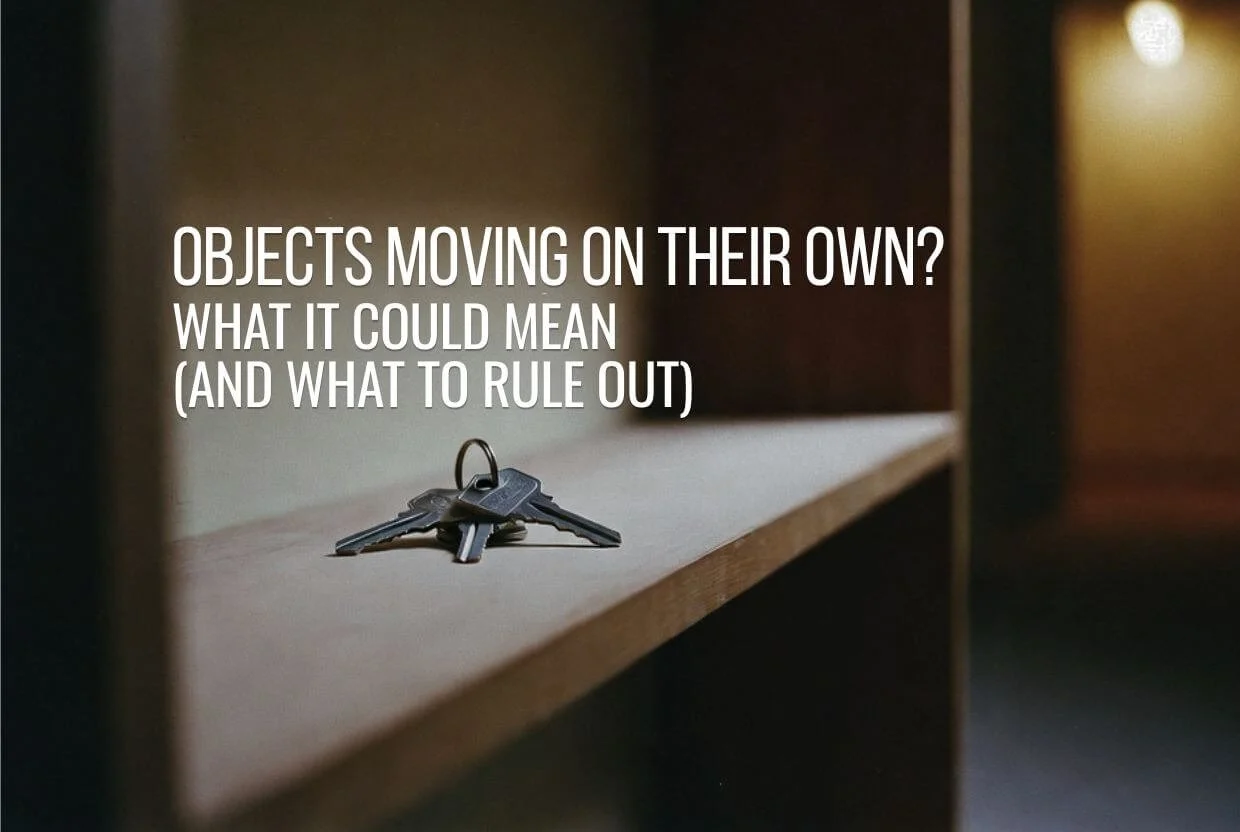
Quick answer: Objects that seem to move on their own are usually explained by memory gaps, vibration, uneven surfaces, air movement, pets or other people. Investigators look more closely when the same object moves repeatedly, witnesses report it independently, or it forms part of a wider pattern.
You put your keys on the kitchen counter. You are certain of it. Twenty minutes later they are on the windowsill in the hallway, and you have no memory of moving them. Or a picture frame that has sat in the same spot for years is suddenly face down on the shelf. Or a glass slides off a surface that has held it perfectly well for months.
Most of the time, there is a boring answer. Humans are spectacularly unreliable when it comes to remembering where they put things, and houses are full of subtle physics that can nudge objects in ways that look impossible until you understand the cause. But occasionally, the boring answers do not fit. The object turns up somewhere you genuinely could not have placed it. The same item keeps being interfered with. Multiple people in the household notice the same thing without comparing notes. And at that point, a different set of questions starts to feel reasonable.
This post covers both sides honestly. It walks through the ordinary explanations that account for most cases of objects apparently moving on their own, then looks at the patterns that make investigators pay closer attention, and finishes with practical steps for working out which category your experience falls into.
Why We Misplace Things More Than We Realise
Before looking at anything unusual, it is worth understanding just how unreliable human memory is when it comes to routine physical actions. This is not an insult. It is a well-documented feature of how the brain manages attention.
Autopilot and Inattentional Blindness
Most of the physical actions you perform at home happen on autopilot. Putting down your phone, placing a mug on the side, dropping your keys by the door. These are low-priority actions that your brain processes without allocating conscious attention. The technical term is automaticity: you do the thing, but you do not form a clear memory of doing it because your mind was occupied with something else at the time.
This means you can genuinely move an object from one place to another and have absolutely no recollection of it five minutes later. When you find the object in an unexpected spot, the gap in your memory feels like something external must have intervened. In the vast majority of cases, the external force was you, operating on autopilot while thinking about dinner or replying to a text.
Confirmation Bias and Pattern Detection
Humans are wired to detect patterns, even where none exist. Once you start noticing objects being out of place, your brain begins scanning for further examples. A pen that rolled behind a monitor becomes evidence. A shoe that ended up under the wrong chair becomes suspicious. Things that you would never have registered before are suddenly filed under “that is strange” because your attention has been primed.
This is not a criticism. It is how the threat detection system works. But it does mean that a single unusual incident can create a cascade of perceived incidents that are actually just normal household entropy being noticed for the first time.
Physical Causes That Look Impossible
Houses are not static. They expand, contract, shift, and vibrate in ways that can produce genuinely surprising object movement. Before assuming anything unusual, it is worth checking whether the building itself is responsible.
Vibration and Traffic
If you live near a road, a railway line, or any source of regular vibration, objects on smooth surfaces can migrate over time. A glass on a polished shelf near a window that faces a busy road can move measurably over the course of a day. The movement is too slow to see in real time but obvious when you notice the glass is no longer where you left it. Heavy vehicles, trains, and even underground services can all transmit vibration through the structure of a building.
Thermal Expansion and Contraction
Shelves, worktops, and mantlepieces are affected by temperature changes. A wooden shelf that sits above a radiator will expand slightly when the heating comes on and contract when it goes off. That expansion can be enough to shift a lightweight object toward the edge. Over repeated heating cycles, the object creeps until it reaches a tipping point and falls. This is one of the most common explanations for things “falling off shelves for no reason” and it is almost always worse in older properties with less consistent heating.
Uneven Surfaces and Air Currents
Very few surfaces in a home are truly level. A worktop that appears flat may have a slight gradient that is invisible to the eye but enough to cause a smooth-bottomed object to drift. Combine this with a draught from a window, a door opening elsewhere in the house, or even the pressure change from the central heating kicking in, and you have a recipe for objects appearing to move without being touched.
Pets and Wildlife
This one sounds obvious, but it catches people out more often than you would expect. Cats are particularly skilled at moving objects silently and without leaving obvious evidence. A cat jumping onto a surface, nudging something, and jumping down again can happen in seconds while you are in another room. Mice, rats, and even birds entering through loft spaces can displace objects in ways that seem inexplicable if you do not know they are there. If you have pets, or if your property has any pest access points, this deserves serious consideration before anything else.
The Disappearing Object Phenomenon
One specific pattern comes up often enough that it has its own informal name: the disappearing object phenomenon. This is the experience of an item vanishing from a known location and reappearing later, sometimes in the same place, sometimes somewhere entirely different, and sometimes somewhere so unlikely that an accidental explanation feels like a stretch.
Researchers in psychology have studied this as an example of how memory and attention fail under stress or distraction. The most common explanation is that you moved the object during a moment of low attention, searched for it while your brain was still locked onto the wrong location (a phenomenon called “looking without seeing”), and then found it later when your attention had reset. This is genuinely how it works in most cases, and knowing that can save a lot of anxiety.
Where it gets more interesting is when the object reappears in a location that does not make any practical sense. A set of keys found inside a closed drawer that nobody opened. A piece of jewellery that turns up in a room you have not been in. A book placed neatly on a shelf you know was empty that morning. These are the accounts that sit in the space between forgetfulness and something harder to explain, and they are one of the most commonly reported experiences in homes where other unusual activity is also occurring.
What Investigators Actually Look For
At KASE Paranormal, we do not walk into a home and announce that objects are moving because of a ghost. We also do not walk in and announce that the homeowner is simply forgetful. What we do is look for patterns, because patterns are what separate the ordinary from the genuinely unusual.
Repetition With the Same Object
When the same item keeps being affected, that is worth noting. A picture frame that turns face down repeatedly. A specific ornament that is always out of position. Keys that migrate to the same unusual spot. The more specific and repetitive the pattern, the harder it becomes to attribute it to general absent-mindedness or random physics.
Multiple Witnesses Without Coordination
One person noticing objects out of place could be memory, stress, or attention. Two or more people in the same household noticing the same thing independently, without having discussed it first, is a different picture. When someone mentions to us during an initial conversation that their partner or child has also noticed something “off” with certain objects, and both descriptions point to the same area or the same items, we treat that as a meaningful data point.
Timing and Context
Objects that seem to move or go missing during specific circumstances are more interesting than random displacement. Activity that clusters around emotional events, arguments, periods of high stress, or particular people being present in the house follows a pattern that has been documented in poltergeist research since the 19th century. Parapsychologists Alan Gauld and A.D. Cornell analysed poltergeist cases from 1800 onward and found that 64% involved the movement of small objects, with activity often linked to a specific individual in the household, frequently an adolescent or someone under significant emotional pressure.
We are careful about how we frame this. It does not mean someone is “causing” objects to move with their emotions. It means the pattern exists in the data, and it is a pattern we pay attention to.
Activity Alongside Other Phenomena
Object movement on its own, without any other unusual activity in the home, is almost always explainable. Where it becomes part of a larger picture is when it occurs alongside things like unexplained sounds, temperature anomalies, electrical behaviour that an electrician cannot account for, or the feeling of a presence. Our guide to haunted house signs we see in real cases covers these broader patterns in detail. Object displacement that fits into a wider cluster of activity is treated very differently from a standalone incident.
The Poltergeist Question
The word poltergeist comes from the German for “noisy ghost” and has become a catch-all term for any physical disturbance attributed to paranormal activity. In reality, what gets labelled as poltergeist activity covers a wide spectrum, from a single item falling off a shelf to sustained, violent disruption involving multiple objects.
True poltergeist cases, in the sense used by researchers, are rare. They tend to follow a recognisable arc: activity starts small, escalates over time, reaches a peak, and then fades. They are usually focused around a specific person rather than a specific place, which distinguishes them from location-based hauntings where the building itself seems to hold the activity. Our types of hauntings guide explains this distinction in more detail.
What we see far more often than classic poltergeist activity is low-level object displacement in homes where something else also feels “off.” A handful of objects being found in unexpected places over a period of weeks, combined with other experiences like sounds or atmosphere changes, does not necessarily point to a poltergeist. It points to a situation worth investigating properly. We do not use dramatic labels. We look at the evidence.
What You Can Do Right Now
If objects in your home are turning up in unexpected places and you want to get a clearer picture of what is happening, there are some straightforward steps you can take before deciding whether to involve anyone else.
Start a simple log. Every time something seems out of place, note the date, time, which object, where you expected it to be, and where you found it. Include who was home, what the household was doing, and anything else that might be relevant such as whether the heating was running, whether any doors or windows were open, or whether emotions were running high. Two weeks of consistent logging can reveal patterns that are invisible in the moment.
Test the physical explanations. Place a small object on the surface where things keep moving and mark its position with a pencil dot or a piece of tape. Leave it undisturbed and check it periodically. If it moves, you may have a vibration, gradient, or expansion issue. If it stays put while other things continue to move, that is useful information too.
Rule out access. If you have pets, try restricting their access to the affected area for a period and see whether the activity continues. If there is any possibility of pest activity, check for droppings, gnaw marks, or entry points. An honest assessment of who and what can physically reach the objects in question eliminates a lot of uncertainty.
Talk to the other people in your home. Ask open questions rather than leading ones. “Have you noticed anything odd lately?” rather than “Have you seen things moving?” If their unprompted descriptions match yours, that is worth recording.
If the activity persists after you have worked through the practical possibilities, and particularly if it is part of a broader pattern of experiences in the home, our guide to what to do if you think your house is haunted covers the next steps in detail. And if you would like someone to take a proper look, KASE Paranormal offers free, private investigations for homes and businesses across Kent and the South East. Every case starts with a conversation. You can reach us through our contact page.
Get In Touch
KASE Paranormal is a private paranormal investigation team based in Kent, serving homes, businesses, and historic locations across the South East of England. All investigations are carried out free of charge.
If you would like to reach out, you can:
Use a short contact form to describe what you are experiencing in your own words: https://www.kaseparanormal.co.uk/contact-us
Request a free chat about your situation in the contact form
Contact us via email: info@kaseparanormal.co.uk
Find us on social media:
Facebook at Kent and South East Paranormal
Instagram @KASEParanormal
X/Twitter @KASEParanormal
You can also read other articles on our blog if you want to think things over before deciding what to do next: https://www.kaseparanormal.co.uk/blog