
Romantic Ghost Stories: When Love Outlasts a Lifetime
Not every love story ends with a happily ever after. Some end in betrayal, tragedy, or a quiet grief that never finds its way out. And in a few rare cases, the story does not end at all.
Across Kent and the wider South East, some of the most enduring hauntings are not tied to battlefields or ancient curses. They are tied to love. To jealousy. To promises broken and lives cut short before two people ever had their chance.
This Valentine's Day, we wanted to look at a different side of the paranormal. Not the cold spots and creaking floorboards, but the human stories underneath them. These are accounts rooted in real places you can visit, real histories you can trace, and real emotions that, if the stories are to be believed, have left a mark on the places where they unfolded.
The Lady Lovibond and the Valentine's Eve Shipwreck
If there is one ghost story that belongs to Valentine's Day, it is this one.
On 13 February 1748, so the legend goes, a three-masted schooner called the Lady Lovibond set sail from the Thames and hugged the Kent coastline, bound for Portugal. Her captain, Simon Reed, had recently married. Unable to bear the thought of leaving his new bride Annetta behind, he brought her aboard for the voyage. Below deck, the crew and their guests were celebrating. Music played. Rum flowed. It should have been a joyful crossing.
But the ship's first mate, John Rivers, had been in love with Annetta himself. Some accounts say he had proposed and been rejected. Others say he had served as Reed's best man while silently nursing a jealousy that would not let him rest. Whatever the truth, what happened next brought the celebrations to a sudden and violent end.
While the party continued below deck, Rivers attacked the helmsman, seized the wheel, and deliberately steered the Lady Lovibond onto the Goodwin Sands, a notorious stretch of shifting sandbank off the Kent coast between Deal and Ramsgate. The ship broke apart. Everyone aboard was lost.
That would be a tragic enough story on its own. But the Lady Lovibond is said to have come back.
Exactly fifty years later, on 13 February 1798, the captain of a ship called the Edenbridge recorded in his log that he had narrowly avoided a collision with a three-masted schooner. He reported hearing the sounds of celebration from the other vessel before it vanished from sight. A rescue party was dispatched from Deal. They found nothing.
In 1848, local fishermen saw what they believed was a ship breaking apart on the Goodwin Sands. Lifeboats were launched. Again, nothing was found. In 1948, Captain Bull Prestwick reported seeing a ship matching the Lady Lovibond's description surrounded by a pale, unnatural glow as it sailed toward the Sands.
When the anticipated appearance came around in 1998, crowds gathered on the Kent coast. No ship appeared.
Whether the Lady Lovibond was ever a real vessel is genuinely uncertain. Researchers have found no record of the ship, its captain, or the wreck in contemporary shipping logs. The earliest known written account dates from a 1924 newspaper article. Some historians believe the story may have been crafted specifically as a Valentine's Day tale, borrowing elements from other maritime tragedies on the Goodwin Sands, where over a thousand ships have been lost since records began.
But that is part of what makes it so compelling. Even if the Lady Lovibond is more legend than history, the story has endured for a reason. A love triangle, a wedding voyage, a betrayal, and a ship that keeps trying to finish its journey. It is the kind of story that lodges itself in a place and refuses to leave.
Lady Blanche de Warrenne and Rochester Castle
Rochester Castle has stood above the Medway for nearly a thousand years. It has seen sieges, fires, and centuries of use and neglect. But its most poignant ghost story is not one of war. It is one of love gone wrong.
In the 13th century, Lady Blanche de Warrenne was said to have been courted by more than one admirer. Among them were Ralph de Capo, to whom she was promised, and Gilbert de Clare, who refused to give up his pursuit. The rivalry between the two men escalated, and during a confrontation at the castle, de Capo fired a crossbow bolt intended for his rival. The bolt glanced off de Clare's armour, changed direction, and struck Lady Blanche in the chest. She died from the wound.
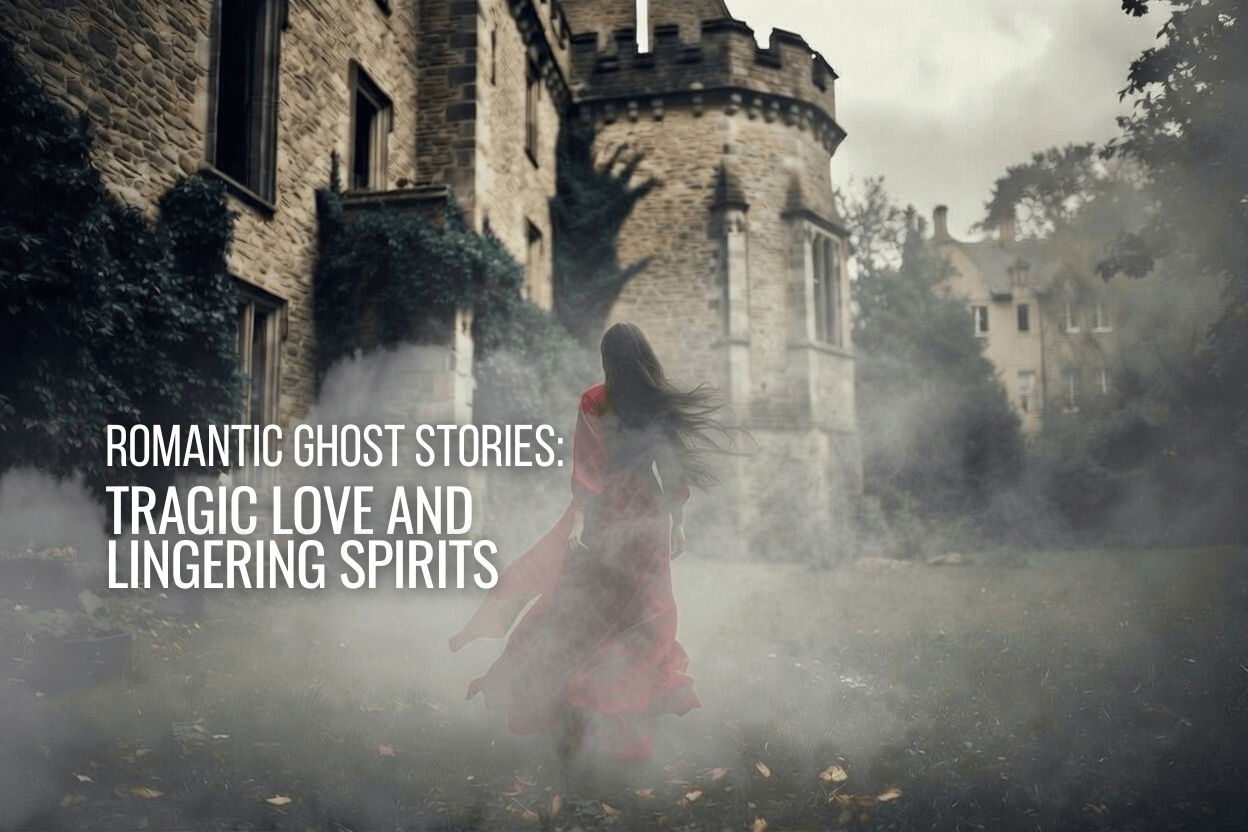
Her ghost is said to walk the battlements of Rochester Castle still, long hair loose and gown trailing behind her. Witnesses describe a fleeting figure pacing back and forth along the top of the walls before vanishing. She appears briefly and then is gone, as though she is still looking for something she never found.
Rochester Castle is one of the best-preserved Norman keeps in England and is open to visitors. If you have read our post on Haunted Kent, you will know this county does not lack for stories, but Lady Blanche's is one of the most quietly affecting.
The Grey Lady of Ightham Mote
Tucked away in a wooded valley near Sevenoaks, Ightham Mote is one of Kent's most atmospheric houses. A medieval manor surrounded by a moat, it has the kind of stillness that makes you lower your voice without quite knowing why.
In the 1870s, workmen carrying out renovations on the upper floor discovered a hidden doorway. Behind it, they found a sealed space containing the upright skeleton of a woman, dressed in the remains of a gown dating to the 1500s.
The discovery gave weight to a local legend that had been circulating for generations. The story told of a forbidden love affair between a young maid employed at the house and the priest who served the family's private chapel. When the relationship was uncovered, the priest, overcome with shame, took his own life. The maid's fate was worse. She was walled up alive by her employer and left to die in the dark.
Whether the skeleton truly belongs to the woman in the story is impossible to confirm. But what followed the discovery has kept the legend alive. Visitors and staff at Ightham Mote have reported seeing a grey figure drifting through the rooms, sometimes crossing the moat as though searching for something on the other side. In one of the bedrooms, people describe sudden, sharp drops in temperature that come and go without explanation.
Ightham Mote is now managed by the National Trust and is open to the public. It is a beautiful place to visit in any season, but there is something about the quieter months, when the grounds are damp and still, that lends the Grey Lady's story a particular weight.
The Bride on Blue Bell Hill
Blue Bell Hill, the stretch of the A229 between Maidstone and the Medway Towns, is widely considered one of the most haunted roads in Britain. The story behind the haunting is not ancient. It happened within living memory, and it is heartbreaking.
On the evening of 19 November 1965, three young women were driving along the road. One of them, 22-year-old Suzanne Browne, was due to be married the following day. Their Ford Cortina collided with a Jaguar travelling in the opposite direction. Suzanne's friend Judith Lingham died at the scene. Suzanne and Patricia Ferguson died in hospital in the days that followed. The wedding never took place.
In the years since, drivers on Blue Bell Hill have reported a series of unsettling encounters. A figure in white appearing in the headlights. A woman stepping out in front of a car and vanishing on impact. In 1974, a driver named Maurice Goodenough told police he had hit a girl on the road and wrapped her in a blanket. When officers arrived, they found the blanket but no girl, and no sign of an accident. Other drivers have reported picking up a hitchhiker who disappears from the back seat before they reach Chatham.
Not all of the reports can be reliably attributed to Suzanne Browne. The road has a longer history of sightings, and some researchers have linked different figures to different incidents. But the story of a bride-to-be killed the night before her wedding has become the emotional centre of Blue Bell Hill's reputation, and understandably so.
The Broken Heart at Shoreham's Crown Inn
Not all tragic love stories involve violence or dramatic endings. Some are quieter, and in their own way, harder to bear.
At the Crown Inn in Shoreham, Kent, a ghost is said to appear outside the building from time to time. The story behind it is a simple one. A young man married the landlord's daughter and the two were happy. But he was press-ganged, taken against his will and sent to sea in the service of the navy, as so many men were in the 18th and 19th centuries.
By the time he finally returned to Shoreham, his wife had died. Unable to live without her, he is said to have died of a broken heart shortly afterwards. His ghost now lingers near the inn, as though still arriving home to deliver news that is already too late.
It is a small story compared to the others on this list. No shipwrecks, no crossbow bolts, no sealed rooms. Just a man who came back too late and could not recover from the loss. That kind of grief does not always make the history books, but it is the kind that people remember.
Emily at Amberley Castle
Just across the county border into West Sussex, Amberley Castle sits in the shadow of the South Downs. Today it operates as a luxury hotel, but its walls date back to the 12th century and carry a story that has not faded with the renovations.
A young woman named Emily worked at the castle and fell in love with the bishop who lived there. She became pregnant. The bishop refused to acknowledge her or the child. With nowhere to turn and no prospect of the life she had imagined, Emily climbed the spiral staircase to the top of the battlements and jumped.
Her presence is said to be felt around the battlements and in the kitchen area of the castle. Staff and guests have described a sense of someone standing close by in places where no one is visible. It is not a dramatic or frightening haunting. It is simply a lingering sadness in a very specific part of the building.
Emily's story is one of power, betrayal, and the kind of abandonment that leaves a person with no good options. It is also, unfortunately, a story that could have happened in any century, not just the distant past.
What These Stories Tell Us
There is a reason ghost stories about love endure in a way that other hauntings do not. A shadowy figure in a corridor is unsettling. A bride who never made it to the altar, a man who came home too late, a woman walled up for the crime of falling in love. Those stories carry something heavier.
As paranormal investigators, we spend a lot of time in places where strong emotions once played out. We do not claim to know why some locations seem to hold onto the past more than others, but we have noticed patterns. The places that produce the most consistent reports are rarely the ones with the most dramatic histories. They are the places where something deeply personal happened. Where someone's world changed in a way they could not come back from.
Whether you believe that grief, love, and loss can imprint on a place, or whether you see these stories as folklore shaped by centuries of retelling, they offer something worth sitting with. Every haunting started as a human experience. Behind every grey lady, every phantom bride, every restless figure on the battlements, there was a real person who loved someone and lost them.
This Valentine's Day, we think that is worth remembering.
Further Reading
If you are interested in the history and hauntings of our region, you might enjoy some of our other posts. Our guide to Haunted Kent explores why this county has so many ghost stories. Our post on Pluckley, often called the most haunted village in England, looks at what it is actually like to investigate there. And if you are curious about what happens when a household reaches out to a team like ours, our guide to what a paranormal investigation involves walks through the process from first contact to follow-up.
What we do
At KASE Paranormal, we offer confidential, respectful support to households across Kent and the South East. We do not charge for our services, and we approach every case without judgement or sensationalism. You can read more about how that works here: https://www.kaseparanormal.co.uk/private-investigations
If you would like to have a conversation - even if you are not sure whether it warrants an investigation, you can get in touch here:
Use a short contact form to describe what you are experiencing in your own words:
https://www.kaseparanormal.co.uk/contact-usRequest a free chat about your situation in the contact form
Contact us via email: info@kaseparanormal.co.uk
Find us on social media:
You can also read other articles on our blog if you want to think things over before deciding what to do next: https://www.kaseparanormal.co.uk/blog