
Canterbury's Most Haunted Locations: A Local Team's Guide
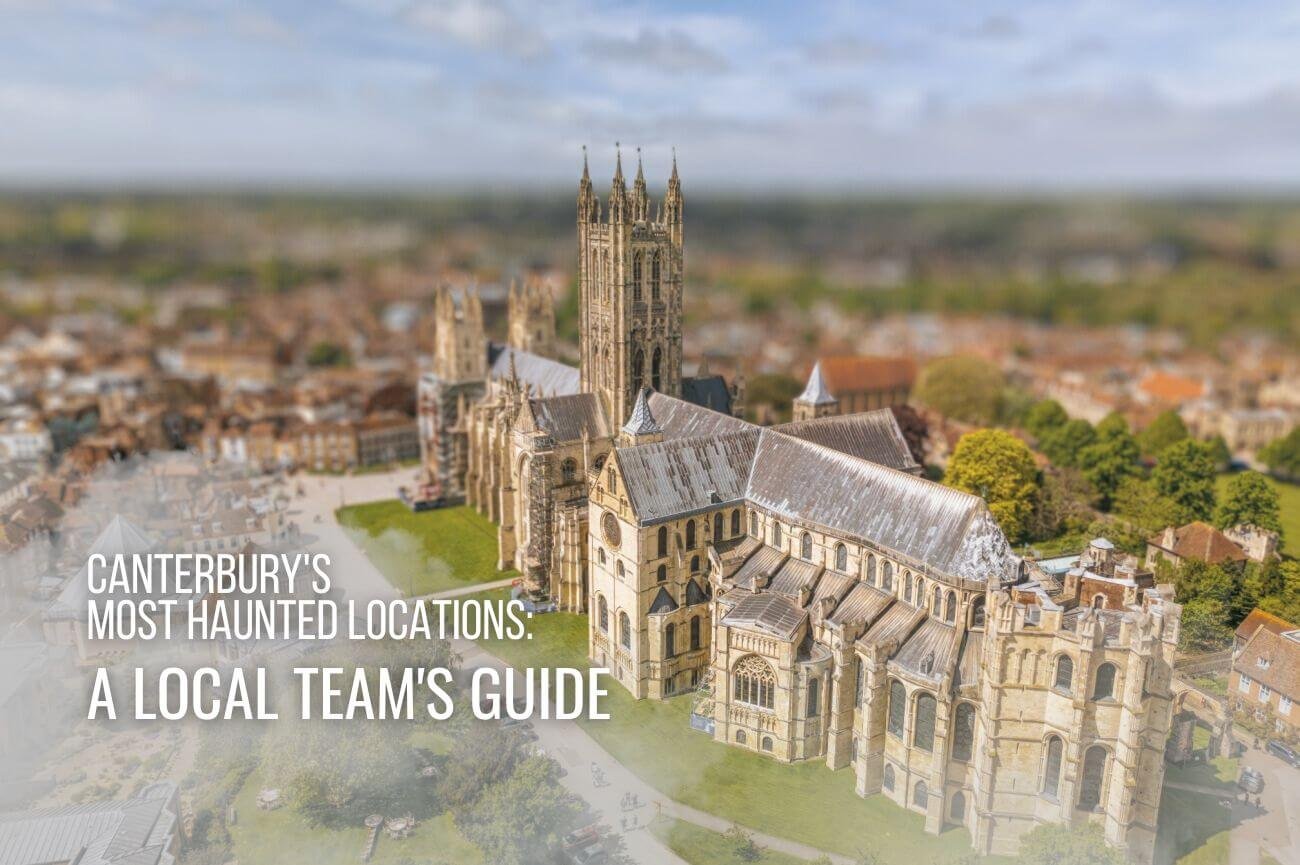
Which places are most often described as haunted in Canterbury? The names that recur in local accounts include Canterbury Cathedral and the Dark Entry, Tiny Tim’s Tearoom on St Margaret’s Street, the Maidens Head in Wincheap, the Burgate monk story, the Grey Girl of St Margaret’s Street and the city’s ghostly cyclist. They range from famous religious and commercial buildings to stories attached to a particular house or stretch of street.
An important distinction: this is a local guide to reported hauntings, not a claim that KASE has investigated every location listed or verified every historical detail. Some accounts have identifiable people, dates or publications behind them; others survive mainly as repeated local tradition. We flag those limits in the individual sections because a compelling story, a witness report and independently reviewed evidence are not the same thing.
KASE’s interest is in what each account would require us to test. In a city built in layers, an old building can produce draughts, shifting temperatures, reverberation, traffic vibration and misleading sound direction. Visitor expectation and a well-known story can also shape what people notice. Reports become more useful when independent witnesses describe the same route, time, sound or figure without prompting, or when a claimed event can be compared with the physical layout and conditions.
Quick answer: Canterbury has an unusually rich concentration of ghost stories, but the quality of the supporting evidence varies. Use this guide to understand what is reported at each location, where the story comes from where known, and how a Kent-based investigation team would separate atmosphere and folklore from a repeatable observation.
If your interest is not sightseeing but unexplained activity at a Canterbury home or business, KASE offers confidential private investigations across Kent and the South East. You can contact us for a free, no-pressure conversation without deciding in advance that the cause is paranormal.
Canterbury Cathedral and the Dark Entry
You cannot write about haunted Canterbury without starting here. The Cathedral has stood in some form since 597 AD, and the current building dates largely from the 12th century. It is the site of one of the most significant events in English history, the murder of Archbishop Thomas Becket in 1170, and has been a place of pilgrimage, political power, and spiritual devotion ever since.
The Cathedral's most well-known ghost, however, is not Becket. It is Archbishop Simon Sudbury, who was beheaded during the Peasants' Revolt in 1381 by followers of Wat Tyler. His body was buried at Canterbury, but his head was taken to Sudbury in Suffolk. Despite this, witnesses have described a full, bearded figure in grey robes moving through the tower that bears his name. Some accounts describe him entering bedrooms and apparently tucking occupants into bed, which is an unusually domestic detail for a ghost story of this age.
Then there is the Dark Entry, the narrow vaulted passage that connects the Green Court to the old infirmary cloister. According to tradition, this is haunted by the spirit of Nell Cook, a servant who poisoned a canon and his lover after discovering their affair. As punishment, she was reportedly buried alive beneath the flagstones. The story was popularised by R.H. Barham in The Ingoldsby Legends (1837), and Barham himself was a Canterbury native, so there is a fair chance the tale was embroidered for literary effect. That said, the passage itself has an atmosphere that is hard to ignore, and reports of unease in the Dark Entry predate and postdate Barham's version.
Phantom plainchant has also been reported within the Cathedral grounds, along with sightings of an unidentified nun and a monk walking the cloisters with what witnesses describe as a confused or troubled expression. Whether these are separate phenomena or variations on the same account is difficult to say. Locations this old tend to accumulate stories, and not all of them are distinct events.
If you want to understand more about why some locations seem to hold onto activity while others do not, our blog on the Stone Tape Theory explores one of the more commonly discussed explanations.
Tiny Tim's Tearoom, St Margaret's Street
This is arguably the most unusual haunted location in Canterbury, and one of the most unsettling once you know the full story.
The building on St Margaret's Street is centuries old and has had multiple lives. It was once connected to a notorious local figure, Sir Geoffrey Newman, and later operated as a Chinese restaurant before being damaged in a fire. During the renovations that followed, workmen made a deeply disturbing discovery in the attic. Behind the walls were the mummified remains of three children, each clutching a Bible. The Bibles were inscribed with the date 1503. Alongside the children, mummified cats and dogs were also found, thought to have been placed there during the original construction as a folk practice to ward off evil spirits.
The discoveries did not stop there. Behind 186 wall panels throughout the building, individual bundles were found containing teeth, ringlets of hair, and the names and dates of birth of additional 16th century children.
Since the renovation, staff and visitors have reported hearing children's laughter upstairs when no one else is in the building, the sound of small feet on the floorboards, and objects being moved. The tearoom now maintains a "Ghost Room" on the upper floor where visitors can read about the history. It is one of those places where the line between local legend and documented archaeology is genuinely thin.
The Maidens Head, Wincheap
The Maidens Head is one of the oldest pubs in Canterbury, with the building dating back to around 1446. It operated quietly for centuries before making local headlines in the early 2020s.
When the landlord converted the upper floors into guest rooms, the builders were the first to report feeling uncomfortable. One of them told the landlord directly that something about the space did not feel right. Once the rooms opened to guests, the reports escalated. A woman staying in one of the rooms described a glass launching itself at the wall while she was lying in bed. Guests reported car keys vanishing from locked rooms. Cleaners described a persistent, unexplained cold in specific areas.
The incident that drew the most attention was the pub's jukebox reportedly playing a song by The Stranglers after it had been unplugged. The landlord, Jeremy Stirling, was open about the fact that he had not personally witnessed anything, but acknowledged that too many people had reported experiences for him to dismiss them entirely.
From an investigative standpoint, pubs of this age are always interesting. Buildings that have seen hundreds of years of human activity, strong emotions, conflict, celebration, and everything in between, tend to be the ones where reports cluster. Whether that is because something is genuinely present or because older buildings simply produce more environmental anomalies (draughts, settling timbers, unusual acoustics) is always the first question we would look at.
The Burgate Monk
One of the quieter Canterbury ghost stories, but one that stands out for its resolution.
In the early 20th century, a resident of a house on Burgate reported repeatedly seeing the figure of a monk in her home. The figure appeared sad, and one arm was noticeably bent at an unusual angle, always in the same direction. Rather than simply living with the experience, the woman investigated. She had the floors of the house examined, and beneath them a skeleton was discovered, buried with one arm bent in the exact position the ghost had shown.
She arranged for the remains to be given a proper Christian burial. According to her account, the next time the figure appeared, its expression had changed. The sadness was gone.
This is one of those stories that is difficult to verify completely at this distance, but it recurs in Canterbury's local history and was documented by more than one source during the period. If even partially true, it raises the kind of questions that make this work worth doing. What would cause a figure to appear repeatedly in the same posture? Why would the behaviour change after the physical remains were moved? We do not claim to have answers, but we think the questions matter.
The Grey Girl of St Margaret's Street
In the early part of the 20th century, a property on St Margaret's Street (now an estate agent) was the site of a recurring apparition. Every Friday morning at five o'clock, a young woman dressed in grey was seen entering the front door and walking up the staircase before disappearing.
The regularity of the sighting is what makes this one noteworthy. Residual hauntings, where the same event appears to repeat on a loop without interacting with the living, often follow patterns tied to specific times or conditions. A figure appearing at the same time, on the same day, following the same path, fits that pattern closely.
The story gained an additional layer when a female skeleton was later discovered beneath the floorboards of the property, wrapped in grey cloth. Whether the discovery explained the sighting or simply coincided with the existing story is the kind of question that rarely gets a definitive answer. But the consistency of the reports and the physical evidence found afterwards make this one of the more grounded Canterbury accounts.
If you want to understand more about the different ways paranormal activity can present, including the difference between residual and intelligent hauntings, our guide to the types of hauntings covers this in detail.
The Ghostly Mayor
Not every ghost story needs to be dark. Canterbury's most charming reported phantom is a former mayor of the city who has been seen riding his bicycle through the streets he loved during his lifetime.
Multiple witnesses over the years have described the same thing: a man on a bicycle, moving calmly through the city, who simply is not entirely there. No name is consistently attached to the figure, and there is no associated trauma or violent history. If the reports are accurate, this is someone who apparently enjoyed Canterbury so much that leaving was not on the agenda.
It is a reminder that not all reported activity is frightening. In fact, in our experience, the vast majority of it is not. Most people who contact us are unsettled rather than terrified, and what they describe is far closer to "something that does not quite make sense" than anything from a horror film. Our blog on what to expect during an investigation covers this in more detail.
What Makes Canterbury Different
Canterbury's density of reported activity is unusual, even by Kent standards. Part of that is simply age. A city with continuous occupation since Roman times has had more opportunity to accumulate stories than most places. Part of it is the Cathedral, which draws millions of visitors and ensures that any unusual experiences are more likely to be noticed and reported than they would be in a quieter location.
But there is also something about the way Canterbury is built. The narrow streets, the layered construction where medieval buildings sit on Roman foundations, the underground spaces and passageways that run beneath the modern surface. These are the kinds of environments where acoustic anomalies, temperature variations, and unusual air movement are common. They are also the kinds of environments where paranormal reports tend to concentrate.
For us, that overlap is what makes investigation valuable. We do not approach a location assuming the answer is paranormal. We approach it wanting to understand what is actually happening, and that means accounting for the building, the environment, and the history before drawing any conclusions.
Thinking About Getting In Touch?
If you live in Canterbury or anywhere in Kent and the South East and something at home does not feel right, we are happy to have an informal conversation about what you are experiencing. There is no pressure to book an investigation. Sometimes a chat is all that is needed.
You do not need to have all the answers before you call. That is what we are here for.
Use a short contact form to describe what you are experiencing in your own words:
https://www.kaseparanormal.co.uk/contact-usRequest a free chat about your situation in the contact form
Contact us via email: info@kaseparanormal.co.uk
Find us on social media:
You can also read other articles on our blog if you want to think things over before deciding what to do next: https://www.kaseparanormal.co.uk/blog