
Our Equipment: What We Use And Why
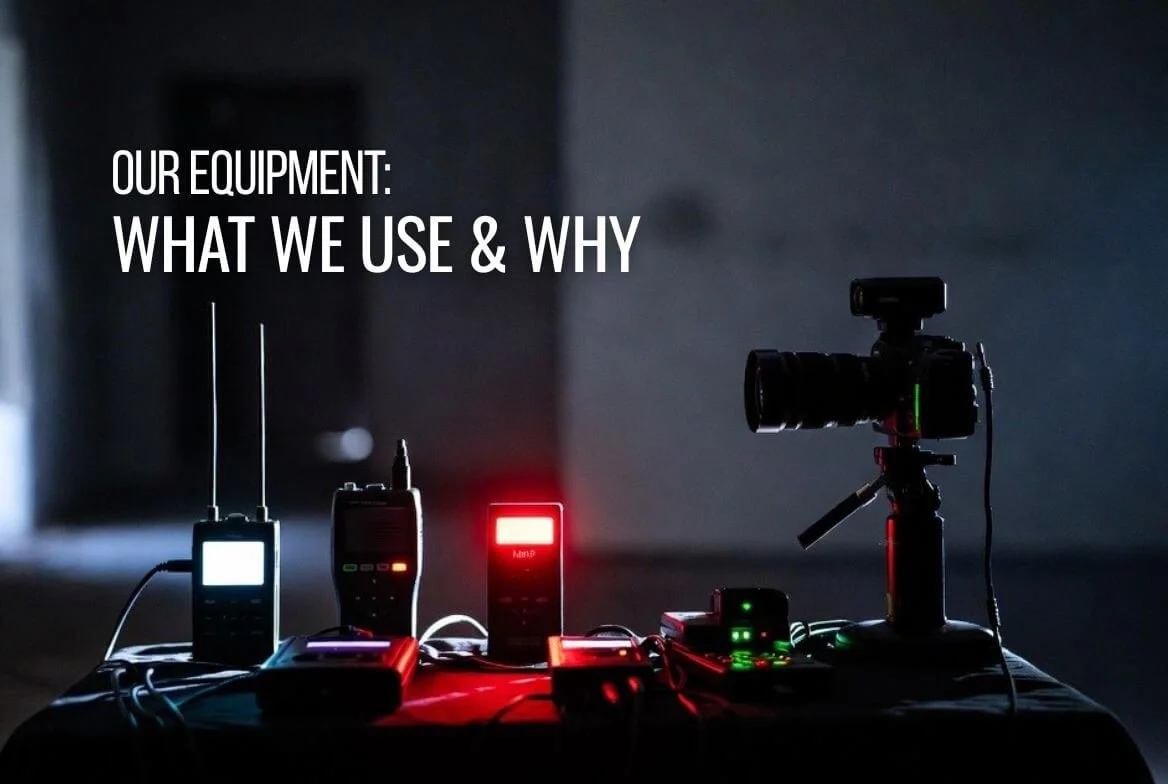
What equipment does KASE Paranormal actually use on an investigation? Our core field kit includes EMF meters, temperature and thermal-monitoring tools, digital audio recorders, infrared and night-vision cameras, still cameras and time-synchronised investigation logs. Depending on the location and the question we are testing, we may also use cat balls, laser grids, torches, the Estes Method, Spirit Talker or a spirit board.
None of those devices detects a ghost. They help us record what was happening, where it happened and whether anything else changed at the same time.
That distinction matters. A flashing meter or an unexplained sound can look dramatic in isolation, but an investigation becomes useful only when we can compare it with the building, the people present, the equipment positions and the rest of the night’s record. Our kit is there to create that record—not to manufacture a conclusion.
If you want an overview of the wider process, visit our Paranormal Investigation Methods & Equipment — https://www.kaseparanormal.co.uk/investigation-methods-equipment hub. This article focuses on what happens to the equipment in the field: how we choose it, position it, test it and decide whether a result deserves further attention.
Before the equipment comes out
Every KASE investigation begins with people and place, not devices.
We speak to the client or location contact, walk the building and establish what has reportedly happened. We look at where an experience occurred, what time it tends to happen, who witnessed it and whether practical causes have already been checked. We also identify obvious sources of contamination such as electrical equipment, heating systems, loose windows, reflective surfaces, traffic, shared walls and areas the team will need to move through.
Only then do we decide what equipment is useful.
A report of footsteps in an empty corridor may call for a locked-off camera and an audio recorder. A repeated cold sensation may justify temperature checks and a thermal survey. Reports involving lights or electrical devices make baseline EMF readings particularly important. Taking every device into every room would create more noise, more accidental interference and more footage to misinterpret.
We don't use equipment to prove ghosts exist. We use it to record what's happening so we can review it honestly and decide what it means.
Our core investigation kit
EMF meters: establishing what is normal
EMF meters measure electromagnetic fields. They are useful because wiring, appliances, chargers, fuse boxes and nearby infrastructure can all produce readings that people may not be aware of.
We use an EMF meter during the initial walkthrough to establish a baseline. If a reading rises later, we first try to identify what changed. Did a phone move closer? Did heating or electrical equipment switch on? Is a cable running behind the wall? Is another investigator carrying a transmitting device nearby?
An unexplained spike is recorded as an environmental change, not labelled as paranormal evidence. It becomes more interesting only if it can be repeated or if it coincides with another independently recorded event.
For a more detailed explanation, see EMF Meters in Paranormal Investigation: What They Actually Detect — https://www.kaseparanormal.co.uk/blog/emf-meters-paranormal-investigation-what-they-actually-detect.
Temperature and thermal monitoring: checking the building first
People often report cold spots, sudden chills or temperature changes. We use infrared thermometers for spot readings and thermal imaging for a wider view of heat patterns across a room.
The first task is to understand the building. Old walls, draughts, open chimneys, poorly sealed windows, radiators, pipes and cold bridging can all create local temperature differences. A thermal image can help us find those ordinary causes rather than relying on how a space feels.
If a change has no obvious structural or environmental source, we log its location, time and duration. We then compare it with the team’s notes, audio, video and other readings. A temperature change remains one data point; it does not become proof simply because it was unexpected.
Digital audio recorders: preserving context around a sound
We use dedicated digital audio recorders and, where appropriate, phones to document both active sessions and unoccupied areas.
During an active EVP session, questions are asked aloud with clear pauses between them. Investigators identify themselves when entering, leaving or making a noise. During passive recording, a device may be left in a room while the team works elsewhere.
The review is as important as the recording. We compare a possible voice or sound against team movement, speech, traffic, heating, doors, floorboards and recordings made elsewhere in the building. Most sounds have an ordinary source. The ones worth retaining are those we cannot readily account for after that comparison.
Read more about our process in What Does EVP Mean in Ghost Hunting? How EVP Sessions Work — https://www.kaseparanormal.co.uk/blog/evp-sessions-ghost-hunting-how-we-run-them.
Infrared, night-vision and static cameras: recording occupied and empty spaces
Most investigations take place in low light, so we use infrared or night-vision cameras for continuous visual documentation. Handheld cameras follow the active team; static cameras cover selected areas, including rooms that are temporarily unoccupied.
Before a session we record where each camera is placed, what it can see and what could affect the image. Reflective surfaces, insects, dust, moisture and an investigator moving outside the frame can all create misleading effects.
Static coverage is particularly valuable because it helps us test claims about an empty area. If something appears on camera, we can check whether anybody was nearby and compare its timestamp with the investigation log and other equipment.
Still photography: documenting before interpreting
We photograph rooms, access points, reflective surfaces and equipment positions as part of the initial record. Those images help us reconstruct the conditions later.
We are cautious with apparent orbs, streaks and mist. Dust, insects, moisture, flash and long exposures can all create familiar “paranormal” effects. Our first question is whether we can reproduce the image under the same conditions. If we can, it is not unexplained.
How we keep separate devices on one timeline
Several devices producing unrelated odd moments do not automatically support one another. The times and locations must agree.
Before an investigation begins, we synchronise camera and recorder clocks as closely as possible. Investigators call out movements and accidental noises. Important moments are entered into the investigation log with a time, location, people present and the equipment involved.
During review, that shared timeline lets us ask better questions:
• Was the room occupied?
• Did another investigator speak or move nearby?
• Did an environmental reading change at the same time?
• Was the effect visible from another camera angle?
• Can the result be recreated?
• Did independent witnesses report the same thing without prompting?
This process often explains an apparently dramatic moment. That is a successful review, not a disappointing one.
Experimental tools: useful prompts, lower evidential weight
Some tools in our kit are used to structure an experiment or create an opportunity for interaction. We do not give their output the same evidential weight as a clear environmental measurement or a well-controlled audio/video record.
Cat balls
Cat balls light up in response to movement or vibration. We note the floor type, draughts, nearby footsteps and traffic before treating an activation as interesting.
Context changed how we assessed a cat ball during our Kelvedon Hatch Secret Nuclear Bunker investigation — https://www.kaseparanormal.co.uk/blog/paranormal-investigation-kelvedon-hatch-nuclear-bunker. A ball was later found roughly eight feet from where it had been placed. We preserved that observation because its position had materially changed, while also retaining ordinary possibilities and the limitations of the overnight environment.
Laser grids and torches
A laser grid gives a camera a fixed visual pattern that makes movement easier to see. Insects, dust and air movement can still interrupt it, so it is most useful when paired with static video and a clear record of the room.
Torches are primarily safety equipment. If used as a yes-or-no experiment, heat and vibration can affect the switch. We film the whole session and record the setup rather than treating one activation as an answer.
The Estes Method
In an Estes session, one investigator wears noise-cancelling headphones connected to a scanning radio device and cannot hear the questions asked by the rest of the team. They call out what they believe they hear, while the session is recorded for later comparison.
The separation can reduce direct prompting, but it does not prove that a relevant word came from a paranormal source. Radio fragments, expectation and interpretation remain possible. We retain a response only with its full context.
Spirit Talker and spirit boards
Spirit Talker may produce words that feel relevant, but we cannot independently verify how its selection process works. We therefore treat app output as a prompt for observation, never as evidence on its own.
Spirit boards are used only with the agreement of everyone present, and never in a private home if the client is uncomfortable. Sessions are filmed, and the ideomotor effect—unconscious movement of the planchette—remains an important normal explanation.
A real investigation is a system, not a gadget
Our Old Havana Cinema / ATIK investigation — https://www.kaseparanormal.co.uk/blog/paranormal-investigation-old-havana-cinema-atik-romford shows why no single device tells the whole story. The team worked across several floors and logged reports from the maintenance room, main dancefloor, base room and other areas. Device interaction was reviewed alongside audio, video, physical reports, team positions and the building’s conditions.
At Kelvedon Hatch — https://www.kaseparanormal.co.uk/blog/paranormal-investigation-kelvedon-hatch-nuclear-bunker, eight investigators worked across three underground levels for eleven and a half hours. The record included locked-off footage, witness reports, device responses and later review. The value came from being able to compare those sources—not from declaring that one tool had detected a presence.
That is what our equipment is for. It gives us a way to preserve the conditions around an experience so we can test ordinary explanations, identify patterns and be honest about what remains unresolved.
What we do not claim
We do not claim that:
• an EMF spike proves a spirit is present;
• a cold area is automatically paranormal;
• every sound on a recorder is an EVP;
• an orb is a ghost;
• an app-generated word is a message;
• expensive equipment is more truthful than careful observation.
We use equipment because memory is imperfect and investigations are complicated. A timestamped record gives us something concrete to review. It also gives us the ability to say, with confidence, when an apparently unexplained event has a normal cause.
Speak to KASE about an unexplained experience
If something unexplained is happening in your home or at a location you manage, you do not need to diagnose it before contacting us. KASE offers calm, confidential private investigations across Kent and the South East.
Tell us what has been happening through our short contact form — https://www.kaseparanormal.co.uk/contact-us. We will listen first, discuss sensible safety and environmental checks, and explain whether an investigation could help.