
Shadow Figures: What People Report and What We Find
Seen something you cannot explain?
Shadow figures are one of the most frequently reported paranormal experiences we hear about, both from homeowners contacting us for the first time and from our own team members during investigations. If you have seen one and want to understand what you are dealing with, we can help.
If you have ever caught a dark shape standing in a doorway, watched something move along a hallway that should have been empty, or felt certain that a figure was standing in the corner of a room only for it to vanish when you looked directly at it, you are far from alone. Shadow figures are one of the most consistently reported phenomena in paranormal research. They are described across cultures, across centuries, and across every type of location we investigate.
What makes shadow figures particularly interesting from an investigative perspective is how remarkably similar the descriptions tend to be. People who have never read a paranormal blog, never watched a ghost hunting programme, and never spoken to anyone else about their experience will describe almost exactly the same thing. That consistency is something we pay attention to.
In our earlier post on seeing shadows out of the corner of your eye, we focused on the practical causes and the medical and environmental explanations that should always be checked first. This article goes further. Here, we look at what people actually report when they describe shadow figures, the patterns we see across different cases, and what we have encountered during our own investigations across Kent and the South East.
What People Describe When They Report Shadow Figures
The descriptions we receive tend to fall into a handful of recurring categories. Not everyone uses the same language, but the core features are strikingly consistent.
The Peripheral Figure
This is the most common type. A dark shape caught at the edge of vision, usually while the person is doing something entirely ordinary. It might appear in a doorway, at the end of a corridor, or just beyond the boundary of where you are looking. By the time you turn your head, it is gone.
On its own, this is easily explained by normal peripheral vision. The rod cells at the edges of the retina are designed to detect movement and contrast rather than detail, so the brain often fills in the blanks with a human shape. We covered this in detail in our post on shadows in your peripheral vision.
Where it becomes more notable is when the same figure is reported repeatedly in the same spot by different people who have not discussed it with each other.
The Standing Figure
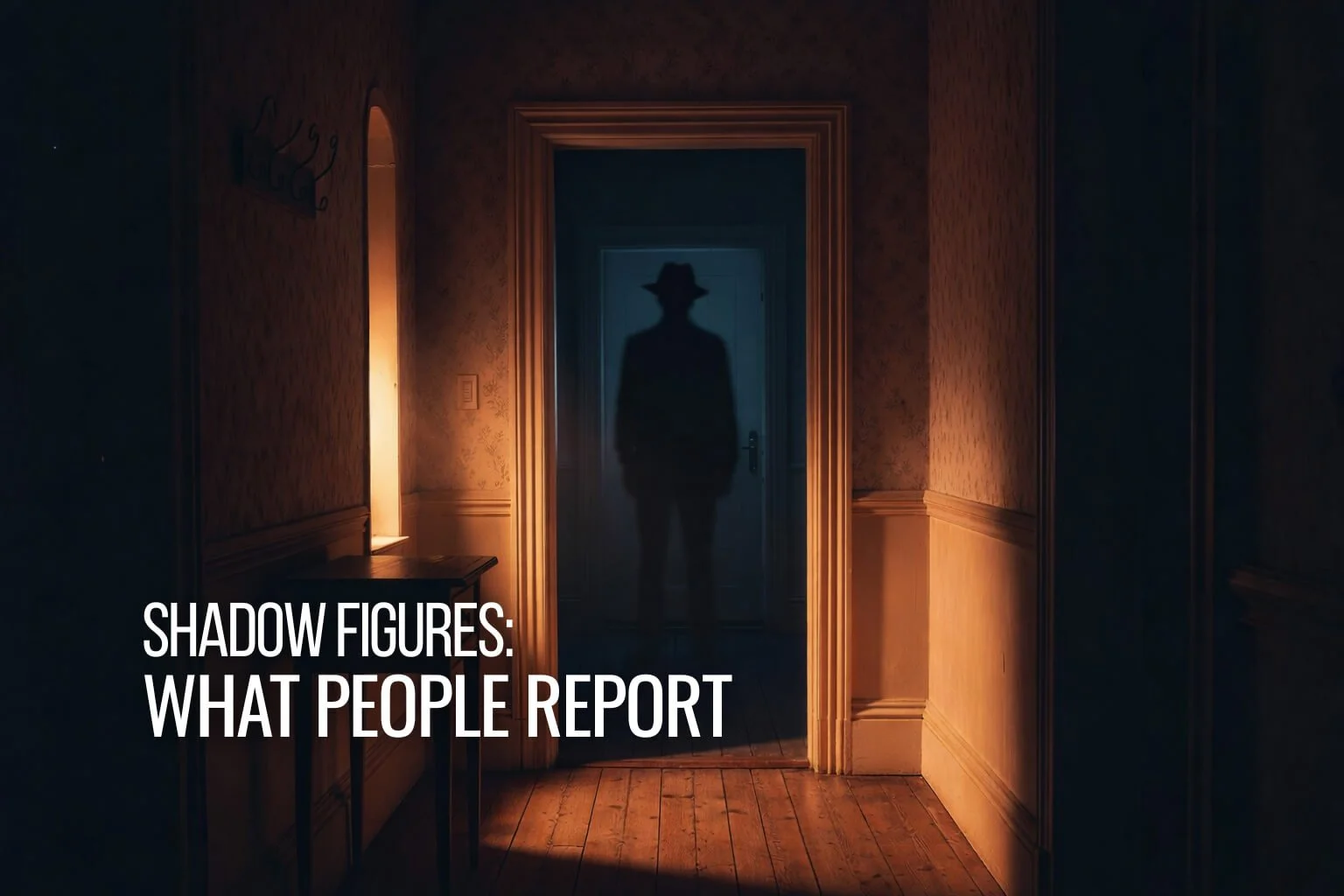
This is the description that unsettles people the most. A clear, dark, human-shaped silhouette standing still, sometimes in a doorway or at the end of a bed. Unlike peripheral glimpses, these are reported in direct line of sight. The figure does not move. It simply stands there, often for several seconds, before fading or disappearing.
People who experience this commonly describe the figure as being darker than the surrounding darkness. Not a shadow cast by something else, but a shape that appears to absorb light. They also frequently report a strong emotional response, typically unease, dread, or the sense of being watched.
The Moving Figure
Some people describe a shadow that actively moves through space. It might walk along a hallway, cross a room, or turn a corner. These descriptions are particularly interesting because they sometimes mirror routes that would have made sense in an older version of the building, such as walking toward a door that no longer exists or following a corridor that has since been partitioned.
This type of report often overlaps with what we describe as residual activity in our types of hauntings guide. The behaviour appears repetitive rather than responsive. It does not seem to notice the person watching.
The Hat Man
One of the most specific and widely reported shadow figure descriptions is what many people refer to as the Hat Man. This figure is described as a tall, dark silhouette wearing what appears to be a wide-brimmed hat or a fedora. The Hat Man is reported across different countries and different decades, and the descriptions remain remarkably consistent even among people with no prior knowledge of the phenomenon.
The Hat Man is frequently associated with sleep paralysis, but not exclusively. Some people report seeing this figure while fully awake and upright. It is one of the more unusual patterns in shadow figure reports because of how specific and repeatable the description is.
What We Notice Across Multiple Cases
When you hear enough of these reports, certain patterns start to emerge. None of the following proves anything on its own, but collectively they form the kind of picture that makes an investigation worth conducting.
Location Consistency
Shadow figures tend to be reported in the same spots within a property. Not randomly throughout the house, but anchored to specific doorways, landings, hallways, or staircases. When we hear that three different family members have all noticed something dark in the same upstairs doorway, that location specificity is significant. We wrote about this pattern in our post on haunted house signs we see again and again.
Witness Independence
The reports that carry the most weight are those where multiple witnesses describe the same thing without having discussed it beforehand. When we are called to a home, we try to speak to household members individually where possible. If two people independently describe the same figure in the same location, behaving in the same way, that is not something we dismiss easily.
Accompanying Phenomena
Shadow figures are rarely the only thing happening. In many of the cases we have investigated, shadow sightings sit alongside other reports: cold spots with no identifiable draught source, unexplained sounds, a persistent feeling of being watched, or pets reacting to apparently empty spaces. When shadow figures form part of a wider cluster of activity, the picture becomes more interesting from an investigative standpoint. Our guide to whether your house might be haunted covers these clusters in more detail.
Emotional Atmosphere
People who report shadow figures almost always describe a strong emotional tone alongside the sighting. The most common is a deep, instinctive unease that feels disproportionate to what they have actually seen. Some describe it as a heaviness in the air. Others say the room felt "wrong" before they even noticed the figure.
This is one of the harder aspects to evaluate as investigators. Emotional responses are subjective and can be influenced by expectation, anxiety, and environment. But when the emotional tone is consistent across witnesses who have not spoken to each other, it is another data point worth recording.
What We Actually Find During Investigations
It is one thing to hear a report. It is another to be in the location, in the dark, with equipment running, looking for evidence that either supports or explains what the homeowner has described.
Here is what our experience at KASE has taught us about investigating shadow figure reports.
They Are Rarely Captured on Camera
This is one of the most frustrating aspects of shadow figure investigations. Despite using infrared cameras, full-spectrum cameras, and static recording setups in the exact locations where sightings have been reported, shadow figures are extremely difficult to capture on video or in photographs. When something is caught, it is almost always ambiguous enough to be debated.
That does not mean the reports are invalid. It means that whatever people are experiencing does not lend itself easily to visual recording. This is consistent with many other types of reported paranormal phenomena and is one of the reasons why witness testimony remains a central part of investigation work. We talk more about how we document evidence in our post on how we run EVP sessions.
EMF Readings Sometimes Correlate
In some investigations, we have recorded elevated electromagnetic field readings in the same areas where shadow figures have been reported. This does not prove a connection, and there are plenty of mundane explanations for high EMF, including old wiring, nearby appliances, and poorly shielded electrical circuits. But when EMF spikes correspond with the specific spots that witnesses have flagged independently, it is worth noting.
High EMF exposure from domestic wiring has also been shown in some studies to cause feelings of unease, nausea, and visual disturbances, which could contribute to or explain some shadow sightings. We always recommend an electrician's check as part of the practical steps before assuming a paranormal explanation.
The Building's History Sometimes Aligns
In cases where shadow figures have been described as moving along specific routes, we have occasionally found that those routes correspond with the original layout of the property. A shadow that walks toward a wall and disappears, for example, may be following a path toward a doorway that was bricked up decades ago.
This is anecdotal and difficult to verify without detailed architectural records, but where we have been able to check, the alignment has sometimes been striking. This is the kind of observation that supports a residual interpretation, the idea that some environments retain an imprint of past activity. We explore this concept in more detail in our article on the Stone Tape Theory.
Our Honest Take: Nobody Knows What Shadow Figures Are
There is no shortage of confident explanations online. Depending on where you look, shadow figures are demons, interdimensional beings, aliens, time travellers, or simply tricks of the light. The truth is that nobody knows for certain, and anyone who tells you otherwise is filling in gaps that the evidence has not filled yet.
Some of these experiences have clear environmental or medical explanations, and we always check for those first. But some do not. The Hat Man, in particular, is a genuinely strange phenomenon. The specificity and consistency of the descriptions across unconnected witnesses, across different countries and decades, is difficult to account for with any single theory. It does not fit neatly into a box, and we think it is more honest to say that than to pretend we have it figured out.
From our position as investigators, shadow figures are reported phenomena. We document them, we look for patterns, we test for environmental explanations, and we stay open to every possibility, including ones we do not yet have a framework for. That is as far as the evidence takes us. It is also the approach we outline in our article on the problem with paranormal TV shows, where we discuss how entertainment-led content often distorts the reality of investigation work.
What we would caution against is letting anyone, online or otherwise, push you toward a single dramatic explanation that increases your fear without offering you anything useful. The vast majority of shadow figure experiences, whatever their cause, are not harmful. If you are seeing them regularly and it is affecting your day-to-day life, the right response is practical steps first and an open mind second.
What To Do If You Are Experiencing Shadow Figure Sightings
If shadow figures are becoming a regular part of your experience at home, here is a practical approach.
Start with the basics. Rule out the medical and environmental causes we outlined in our earlier post on shadows in your peripheral vision. Book an eye test if you have not had one recently. Check your carbon monoxide alarm. Look at your lighting, your sleep patterns, and any medication you are taking.
Keep a simple log. Note when and where you see the figure, what you were doing at the time, who else was in the house, and how you felt. If other household members are willing, ask them to do the same without comparing notes. Two weeks of consistent logging gives you and any investigator you contact something concrete to work with.
If you have done the practical checks and the sightings continue, or if they are part of a wider pattern of unexplained activity, that is a reasonable point to reach out.
How KASE Approaches Shadow Figure Cases
When we are contacted about shadow figures, we treat the report the same way we treat any other: seriously, privately, and without assumptions.
We start by listening. We want to understand what you have experienced, where it happened, how often, and whether anyone else in the household has noticed anything. We ask about the history of the property, any recent changes or renovations, and whether anything else has been happening alongside the shadow sightings.
If an investigation is appropriate, we bring our equipment and set up in the areas where activity has been reported. We monitor for environmental factors, we conduct controlled observation, and we document everything. If we find a straightforward explanation, we will tell you. If we do not, we will share what we observed and discuss what, if anything, might be worth doing next.
We do not charge for home paranormal investigations. We do not sensationalise your experience. And we do not tell you your house is definitely haunted just to justify turning up.
Here’s how you can get in touch:
Use a short contact form to describe what you are experiencing in your own words:
https://www.kaseparanormal.co.uk/contact-usRequest a free chat about your situation in the contact form
Contact us via email: info@kaseparanormal.co.uk
Find us on social media:
You can also read other articles on our blog if you want to think things over before deciding what to do next: https://www.kaseparanormal.co.uk/blog