
Paranormal News This Week: Puma Search, Distant Radio Burst and Earhart Expedition
The KASE Weekly | 14 October 2026
A possible puma has police searching a Bavarian nature reserve, while invented sightings send them in the wrong direction. Astronomers have traced a fleeting radio burst to a surprisingly small galaxy. And the team looking for Amelia Earhart's aircraft has reached the island where it hopes to find an answer.
This week brings a familiar frustration for anyone interested in the unexplained: finding something worth investigating is hard enough without somebody helpfully making things up.
Fur and disorder: fake sightings disrupt the German puma search
Police near Munich Airport are searching for a possible puma after a hunter filmed an animal through a night-vision device late on 6 October. The search began the following day around Notzinger Moos, a nature reserve near Oberding in Bavaria.
According to Bavarian broadcaster BR24, an expert who examined the recording thought a puma was possible. The animal's identity remained uncertain. Officers searched on foot and used drones, helicopters and dogs, without finding the cat.
Then came an unwelcome complication. At an 8 October press conference, Erding police chief Sebastian Pinta warned that AI-generated big-cat pictures were reaching his officers. DPA reported that these false sightings were causing unnecessary enquiries and alarming residents. Pinta said police considered the hunter's original recording authentic. The fake pictures were separate submissions.
By 12 October, the search still had no confirmed animal to show for it. A helicopter sent up after another possible sighting found deer, while mounted officers found no traces or prey remains. The latest DPA account, published by Munich's Abendzeitung, said police were reviewing footage from wildlife cameras installed in the reserve.
A second reported sighting at the airport's visitors' hill appears to have involved a domestic cat, BR24 reported. That may explain that particular alert. It does not identify the animal in the hunter's recording.
The KASE take
There is a real search here, and a real question about what the hunter filmed. An authentic recording can still be difficult to interpret. Size, distance and the animal's movement matter, especially at night. An expert saying a puma is possible gives police a reason to look; it doesn't finish the identification.
The AI pictures make an already awkward job harder. Officers checking an invented sighting cannot spend that time following a useful one. The internet has managed to supply more cats than the search party.
We'd want the full recording, a clear view of the location in daylight and something that establishes scale. Further camera footage, tracks or hair could help settle the question. Until then, neither the unsuccessful search nor the genuine-looking video tells us exactly which animal was there.
A brief radio burst leads astronomers to a very distant galaxy
A flash of radio waves detected in 2024 has now been traced to its home galaxy, giving astronomers a better idea of what might have produced it. The research, led by Manisha Caleb at the University of Sydney, was published in Science on 8 October.
The burst, called FRB 20240304B, was picked up by South Africa's MeerKAT telescope on 4 March 2024. Fast radio bursts last only milliseconds, and many are never seen again. Although the team knew where to look, observations with the Keck telescope could not reveal the faint galaxy behind this one.
The James Webb Space Telescope could. Its observations placed the galaxy at a time when the universe was about three billion years old, making this the most distant fast radio burst yet identified, according to NASA and Keck Observatory.
The galaxy was also much smaller than the researchers expected and busy forming stars. That matters because the age of its stars helps distinguish possible causes of the burst.
One possibility is a collision between two neutron stars, the dense remnants of dead stars. Another is activity on a magnetar, a neutron star with an exceptionally strong magnetic field. Caleb's team argues that the young stellar population favours the magnetar explanation over a merger that would usually take much longer to develop.
The KASE take
A radio signal from deep space is irresistible headline material, but this study is investigating violent natural events, not an alien transmission. The interesting part is that astronomers can learn about a momentary flash long after it has gone, by studying the place it came from.
They have narrowed the possibilities for this burst, rather than solved every fast radio burst at once. We'd be interested to see whether other very distant bursts turn up in similarly young galaxies. That would give researchers more opportunities to test the proposed connection.
The Earhart expedition reaches Nikumaroro
Last week, we covered the departure of a team hoping to investigate a possible clue to Amelia Earhart's disappearance. There is now a confirmed arrival: Purdue University reported on 12 October that the seventeen expedition members had reached Nikumaroro, a remote atoll in Kiribati, after five days at sea.
Their target is the Taraia Object, a feature in the lagoon that expedition leader Rick Pettigrew and his colleagues believe could be connected to Earhart's missing Lockheed Electra. That remains their hypothesis. The arrival announcement reports no aircraft discovery.
Purdue said the team planned to prepare access and move equipment before turning its attention to the Taraia Peninsula on 14 October. The proposed work includes looking for surface material, searching for metal, using sonar and examining whatever lies beneath the lagoon's sediment. Weather and tides will affect access.
The KASE take
Reaching the island is a meaningful step beyond studying photographs. Now the team has a chance to find out whether the feature is wreckage, a natural formation or something else entirely.
Even a piece of aircraft would need careful identification before anyone could connect it to Earhart. Photographs taken before anything is moved, precise records of where it lay, and any surviving markings would all matter.
Purdue is a partner in the expedition, so this is the organisers' progress report. We can share their interest in the search without borrowing their confidence in its target. For now, the boat has arrived. The answer hasn't.
What would persuade you?
One investigation needs a clearer look at an animal, another has found a galaxy that was previously too faint to see, and a third is finally within reach of its target. None benefits from an invented picture or a premature announcement.
The puma story brings that home rather neatly. If you were shown the hunter's recording, what would you want to see next before deciding it really was a big cat?
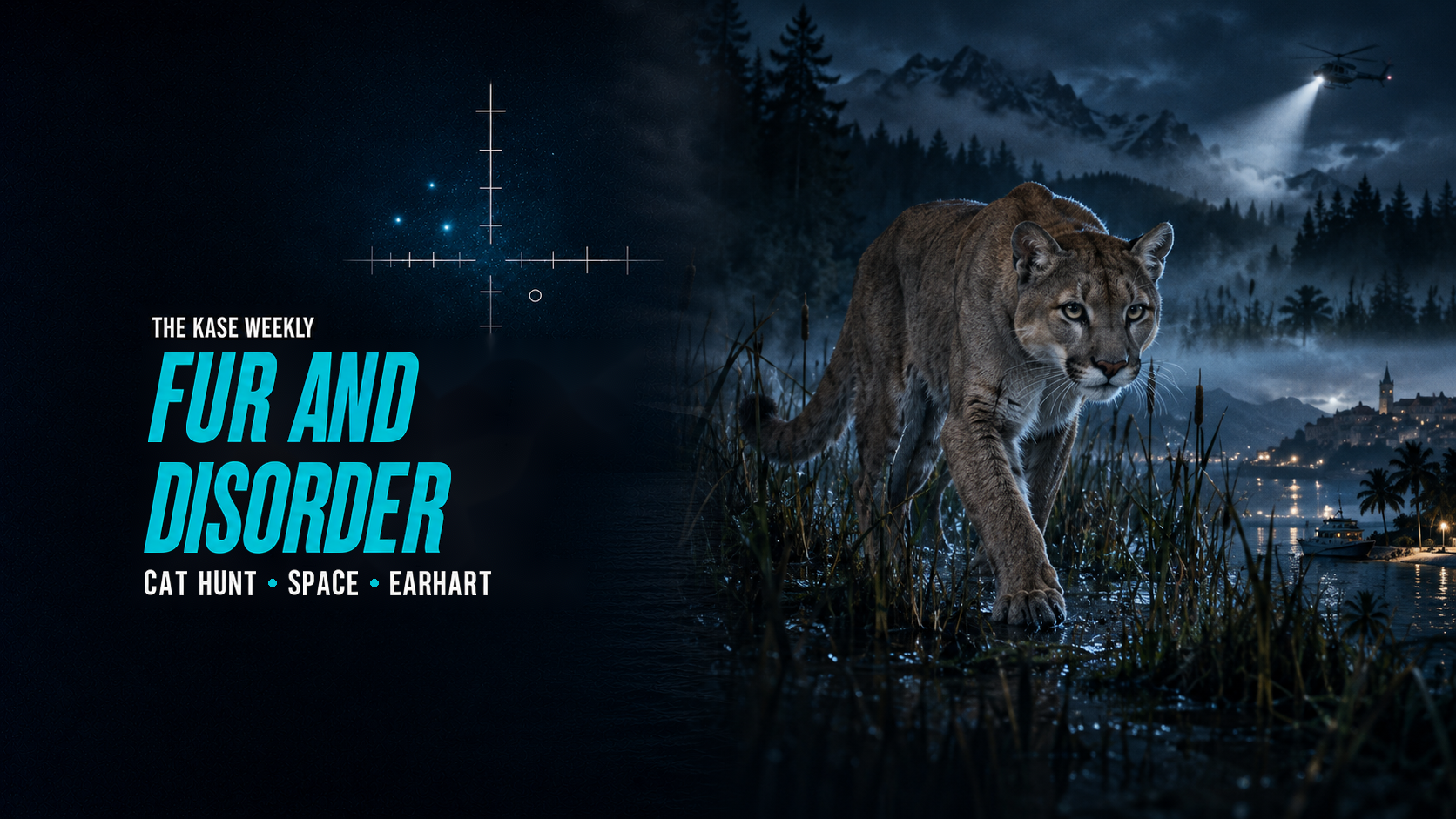
The hero is an AI-assisted editorial illustration, not a photograph of the reported animal, the police search or the Earhart expedition.
Sources and further reading
Bavarian puma search
BR24, Frank Jordan and the BR24 editorial team, 7 October, updated 8 October 2026. The original sighting, search and separate airport alert.
DPA, published by WELT, 8 October 2026. Sebastian Pinta's warning about AI-generated sightings.
Abendzeitung/DPA, 12 October 2026. The unsuccessful weekend searches and wildlife-camera review. The two DPA reports are updates from the same news agency.
Fast radio burst
NASA Webb Mission Team, 8 October 2026, updated 9 October. The observation dates, host galaxy and possible origin.
W. M. Keck Observatory, 8 October 2026. The ground-based observations and the study's findings. Both announcements describe the same research.
Earhart expedition
Purdue University, 12 October 2026. Arrival at Nikumaroro and the planned fieldwork.