
The KASE Weekly | 28 October 2026
A silver object beside a passenger jet. A black triangle over a canyon. And a Utah creature investigation with a rather less exotic answer in the laboratory. This week, the UFO headlines take us from Heathrow to the newly released US files, where the small print is often the most interesting part.
A close call after Heathrow
A British Airways near-miss made headlines on 24 October, but the encounter happened on 24 June. A Boeing 777 leaving Heathrow passed a shiny object near Guildford at about 5,800 feet.
According to the UK Airprox Board's September assessment, the pilot saw it close to the right wing and thought it was probably a drone. The board could not identify it. Radar checks found no corresponding contact.
The board assigned risk category A, its most serious category. That concerns the danger of a collision, not how unusual the object was.
The KASE take
Whatever passed the aircraft, it was in a very bad place. A drone is a credible explanation, although the pilot's brief view was not enough to settle the question.
There is a real mystery here: what was the object, and how did it get so close to a passenger aircraft? Neither an absent radar return nor the word “unidentified” supplies an alien answer. The safety investigation deserves attention on its own terms.
Two cases from the latest US UFO files
The US government's 23 October release includes both the black-triangle account and the Skinwalker investigation below. They are separate cases in the same batch of records. Their publication gives us more to read about what witnesses reported; it does not mean the government has confirmed their explanations.
A black triangle over the canyon
Federal law-enforcement agents described a dark triangular object rising above a ridgeline, hovering, then turning and dropping into a canyon. Their account appears in a 2026 memorandum from AARO, the Pentagon office that investigates unidentified anomalous phenomena. The precise date and location are redacted in the document.
The witnesses reported no sound and estimated that the departure was as fast as a fighter jet. But the memorandum, available here as an archive copy, says no instrument measured its speed. It also describes the object disappearing behind terrain and into canyon shadows. It does not describe it becoming invisible.
The KASE take
The agents' experience with aircraft makes this an account worth investigating. It cannot, by itself, tell us how fast the object travelled or what powered it.
Distance is particularly important. An error in that estimate changes the apparent size and speed. An unfamiliar aircraft or drone should be considered, but simply suggesting one does not explain the reported behaviour either.
The most useful next step would be to compare the witnesses' account with any surviving sensor recordings and aircraft activity in the area. That could help establish whether the movement was as unusual as it appeared.
Skinwalker: the hair had a different story
The newly released Utah report records investigations in March and April 2010. Witnesses described strange lights and dog-like creatures. One woman recalled seeing a transparent, rippling wall roughly twenty years before her interview. She later interpreted it as a portal after reading a book about Skinwalker.
Investigators also collected hair. The report's laboratory pages, numbered 36 and 37, distinguish two hairs from a fence near a reported creature encounter, a comparison sample from a dog, and hair embedded in a red-stained rock.
The fence samples and the dog sample shared a mitochondrial DNA sequence found in domestic dogs. The rock sample was identified as raccoon. Investigators thought the fence hair probably came from the same dog, although that shared sequence alone could not identify an individual animal.
The KASE take
That is why collecting and testing samples matters. The hair gave investigators something they could examine, and the results pointed to familiar animals. Those findings should be part of the story, rather than an appendix everyone skips on the way to the portal.
They do not explain every experience described around the ranch. Equally, a creature story does not make ordinary animal hair extraordinary.
The portal account presents a different problem. We have a witness describing a distant memory, not a recording or a phenomenon researchers could revisit and measure. Her comparison with a heat wave suggests an optical effect is worth considering, but there is too little information to establish a cause. Calling it a portal goes further than the available evidence allows.
What would convince you?
The Heathrow report raises an immediate safety question. The triangle account leaves us wanting better measurements. The Utah investigation shows what can happen when a remarkable story produces something testable.
Which would carry the most weight for you: an experienced witness's account, a clear recording, or a physical sample that an independent laboratory could examine?
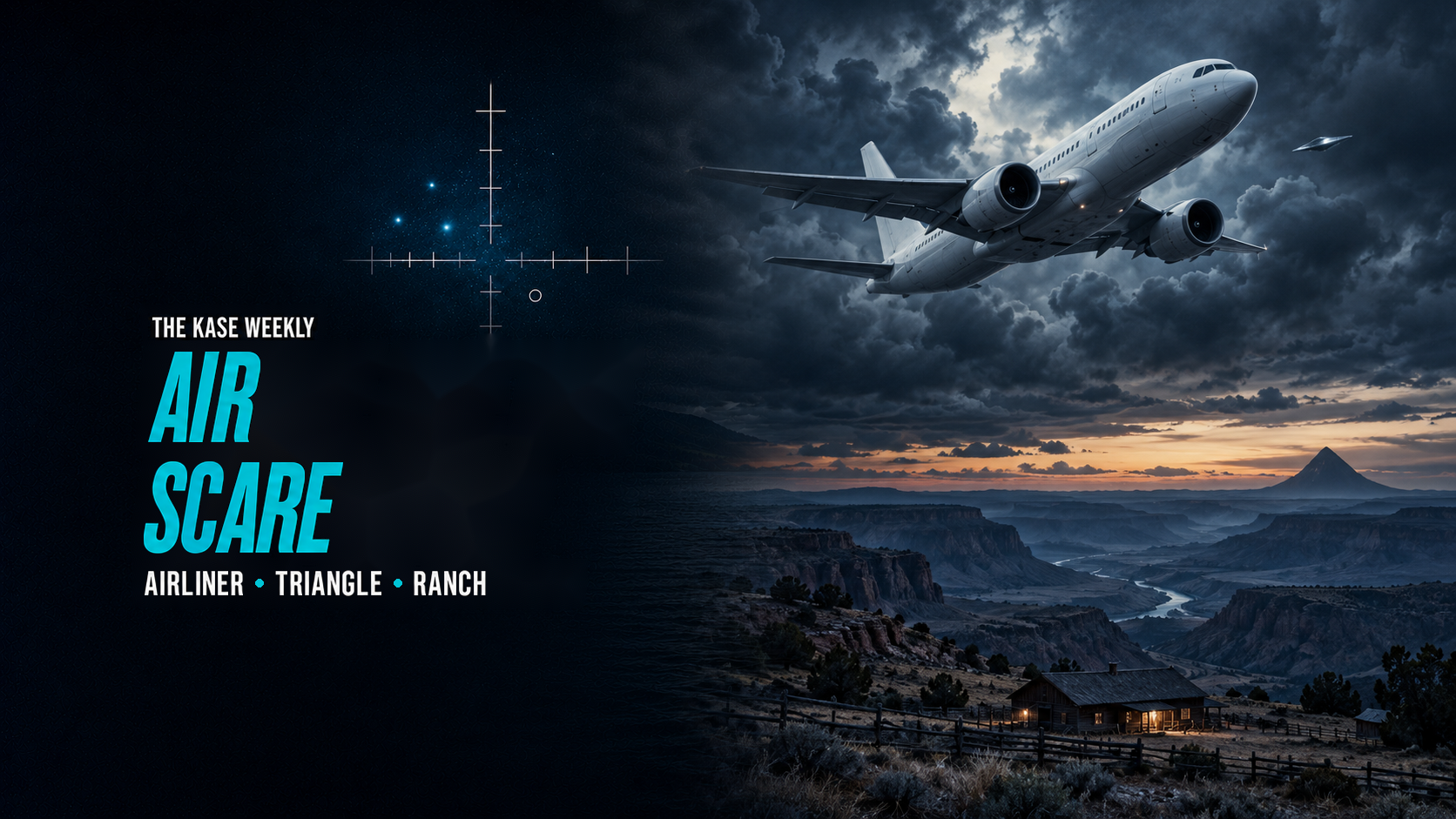
The hero is an AI-assisted editorial illustration of the week’s themes. It does not show the reported encounters or evidence.
Sources and further reading
UK Airprox Board: September 2026 assessment, case 2026127. The 24 June encounter near Guildford.
The Sun, 24 October 2026. The recent British Airways coverage.
UAP Ledger: 23 October release index. A guide to the documents in the US release.
AARO: triangular UAP witness memorandum, 2026. Archive copy of the released government record.
Utah Ranch Investigation, April 2010. Archive copy; the laboratory analysis and sample descriptions appear on printed pages 36–37.