
Why We Are Sceptical of Orb Photography at KASE Paranormal
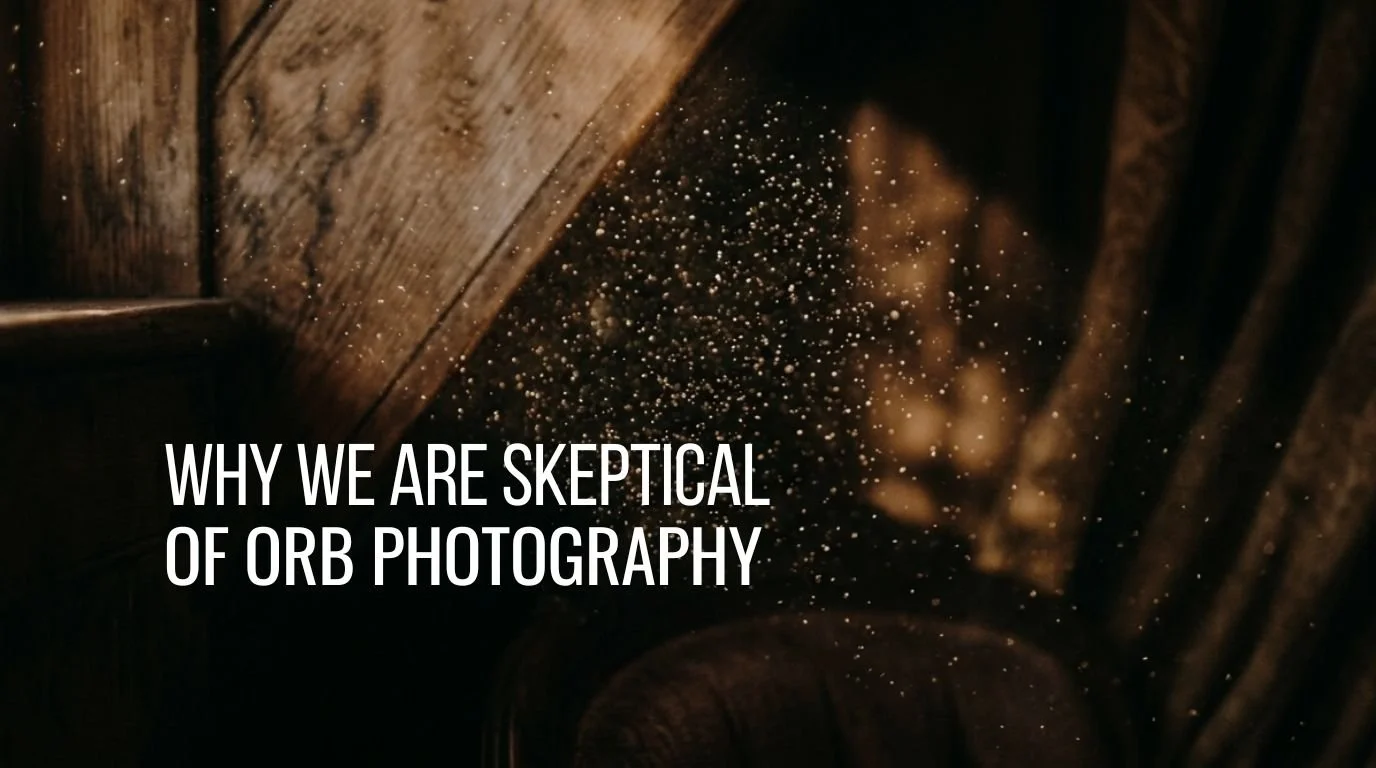
People sometimes send us photographs with a small bright circle floating somewhere in the frame, asking whether we have caught a ghost on camera. It is a fair question. Orbs have become shorthand in the paranormal world for spirit activity, and there are entire corners of the internet built around treating them as evidence. When something unusual is happening at home and a strange circle then turns up in a photo, the connection feels obvious.
So this post is the honest answer. No spin, no hedging. We go into how we work at KASE in more depth on a recent episode of The KASE Files podcast, and this post is the written companion piece to that conversation.
If you’re experiencing activity in your home that you cannot explain, reach out for a free no obligation chat! You don’t have to deal with it alone.
The Short Answer
The vast majority of orbs in photographs are dust, moisture, pollen, or small insects caught by the camera flash. They are not paranormal. They are not spirits. They are particles in the air, lit up at close range, sitting out of focus a few inches from the lens.
We treat orbs with caution because the evidence simply is not there. When someone shows us a photograph with a bright circle in it and nothing else to back it up, we are not going to tell them they have captured a ghost. We owe them a more honest answer than that, even when it is not the answer they were hoping for.
That is the short version. The longer version is worth reading too, because it explains how orbs became such a fixed idea in the field, and why we do not weigh them the way some teams do.
What Orbs Actually Are
This is the part most people have not had explained to them properly.
A camera flash sits very close to the lens on most modern devices, often only an inch or two away. When you press the shutter, the flash fires almost directly along the line of sight of the lens. Anything floating in the air right in front of the camera (a speck of dust, a fragment of pollen, a fine droplet of moisture, a tiny insect) gets fully lit on the side facing the camera and reflects that light straight back into the lens.
Because that particle is much closer to the camera than what you are actually photographing, it sits well outside the focal range. The result is a soft, glowing circle, often with a slight ring or interior texture, hovering somewhere in the frame. It looks ethereal because it is out of focus, not because it has any paranormal origin. Once you know what you are looking for, you start spotting them everywhere: bonfires, barns, attics, foggy mornings, dusty cellars, beaches with sea spray, anywhere there is something small drifting in the air. Our 10 signs your house might be haunted guide deliberately leaves orb photography off the list, because we do not believe it belongs there.
Knowing what causes orbs is not the end of the conversation. It is the start of a more useful one.
Why Digital Cameras Made Orbs Suddenly Common
There is a clue hiding in the history of orb photography, and it is one of the things that pushed us toward scepticism in the first place.
Before the late 1990s, orbs in photographs were barely a topic. Film cameras, particularly older SLRs, had the flash mounted further from the lens, often on a hot shoe several inches above the optical axis. That extra distance meant airborne particles in front of the lens were lit at an angle rather than head-on, and they did not bounce light directly back into the sensor. Orbs in old photographs were rare to the point of being a curiosity.
Then compact digital cameras arrived, and shortly after that, smartphones. These devices put the flash millimetres from the lens, often packed into the same small assembly. Almost overnight, orbs were turning up in everyone's holiday snaps. The paranormal field, rather than asking why this had only just started happening, quickly adopted them as evidence of spirits. A genuine paranormal phenomenon would not wait for a particular camera design to start showing up. The fact that orbs scaled with the rise of compact digital photography tells us something about where they are coming from, and it is not the spirit world.
What We Look For Instead
Fair question, because if we are setting orbs aside, it is reasonable to ask what we are actually treating as worth investigating.
We look for converging evidence, not single anomalies. A cold spot on its own is interesting but not conclusive. An EMF spike on its own could be wiring or a nearby appliance. A noise on an audio recording could be the building settling, or someone moving in the room above. What moves something into the worth a closer look category is when several of these line up together, in the same place, at the same time, alongside witness experiences that match.
That is why our investigations include temperature monitoring, EMF readings, full-spectrum video, multiple audio recorders, and detailed witness interviews. We cross-reference everything. A single photograph with a bright circle in it tells us almost nothing on its own, because we cannot rule out the obvious explanations. A clear voice on a recording at the moment a witness describes feeling watched, captured on two devices at once, with a temperature drop logged in the same window, is a very different kind of conversation.
If you want the full picture of how we approach private work, our private investigations page walks through the process in detail.
What This Means For Your Photos
If you have sent us a photograph with orbs in it, or you are thinking about doing so, a few things follow from all of this.
We will not dismiss your experience. The photograph is one small piece of a bigger picture, and we are far more interested in what has been going on around it. When did you take it? What were you doing at the time? What had you already noticed in the home before you reached for the camera? Those questions matter much more to us than the orb itself.
We may also ask whether the conditions made airborne particles likely. Had a window been open? Was a pet in the room? Had the heating just kicked in and lifted dust off a radiator? Was anyone smoking, vaping, or burning incense nearby? None of these are gotcha questions. They are the same checks we run on our own photographs before we treat anything in them as anomalous.
The aim is not to make you feel silly for asking. Plenty of people send us orb photographs in good faith, and we would much rather have an honest conversation about what is and is not likely than nod along and tell you what you might want to hear.
If your photograph is part of a wider pattern of experiences, that pattern is what we are going to focus on. For more on the practical side of an investigation, our guide on whether a paranormal investigation is safe covers what we actually do, and our post on what to do if you think your house is haunted walks through useful first steps before you reach out.
Why Honest Methodology Matters
Working this way does mean we sometimes disappoint people. Someone arrives at our inbox convinced they have a clear photographic record of a spirit, and we have to gently explain why we are not going to confirm that for them. It is not the easy answer, and it is not always the welcome one.
What we are protecting, though, is the thing that matters most in this field: credibility. The paranormal community has been chipping away at its own reputation for years by treating shaky evidence as conclusive, and orbs are one of the worst offenders. Every time a team confidently labels a dust particle as a spirit, it makes it harder for the field to be taken seriously when something genuinely unexplained does turn up.
It also matters for the people who contact us. If a family is dealing with something they cannot explain, they deserve a team that knows the difference between dust and data. We owe them a clear-eyed assessment, not a confirmation they have caught something on camera when we cannot honestly say so.
If You Want to Talk to Us
If something is going on in your home and you are wondering whether to make contact, please do not let an inconclusive photograph put you off. Activity rarely reveals itself in a single image, and we are far more interested in the pattern of what you have been experiencing than in any one frame.
You can reach us through our contact form without committing to anything. A message does not lock you into an investigation, and we will not pressure you into one. If you want a steer on what to say first, our guide on how to request a private paranormal investigation covers exactly that.
Use the contact form to describe what you have been experiencing in your own words
Send any photographs along with the context around them, when, where, and what was happening at the time
Contact us via email or WhatsApp if you prefer a quicker first message
Find us on social media: Facebook at Kent and South East Paranormal, Instagram @KASEParanormal, X/Twitter @KASEParanormal
You can also hear Dan talking through our approach to evidence in detail on The KASE Files podcast, and read more on our blog while you think things over.