
Paranormal News This Week: UK Panther Photo, Venus Mystery and Strange Sky Lights
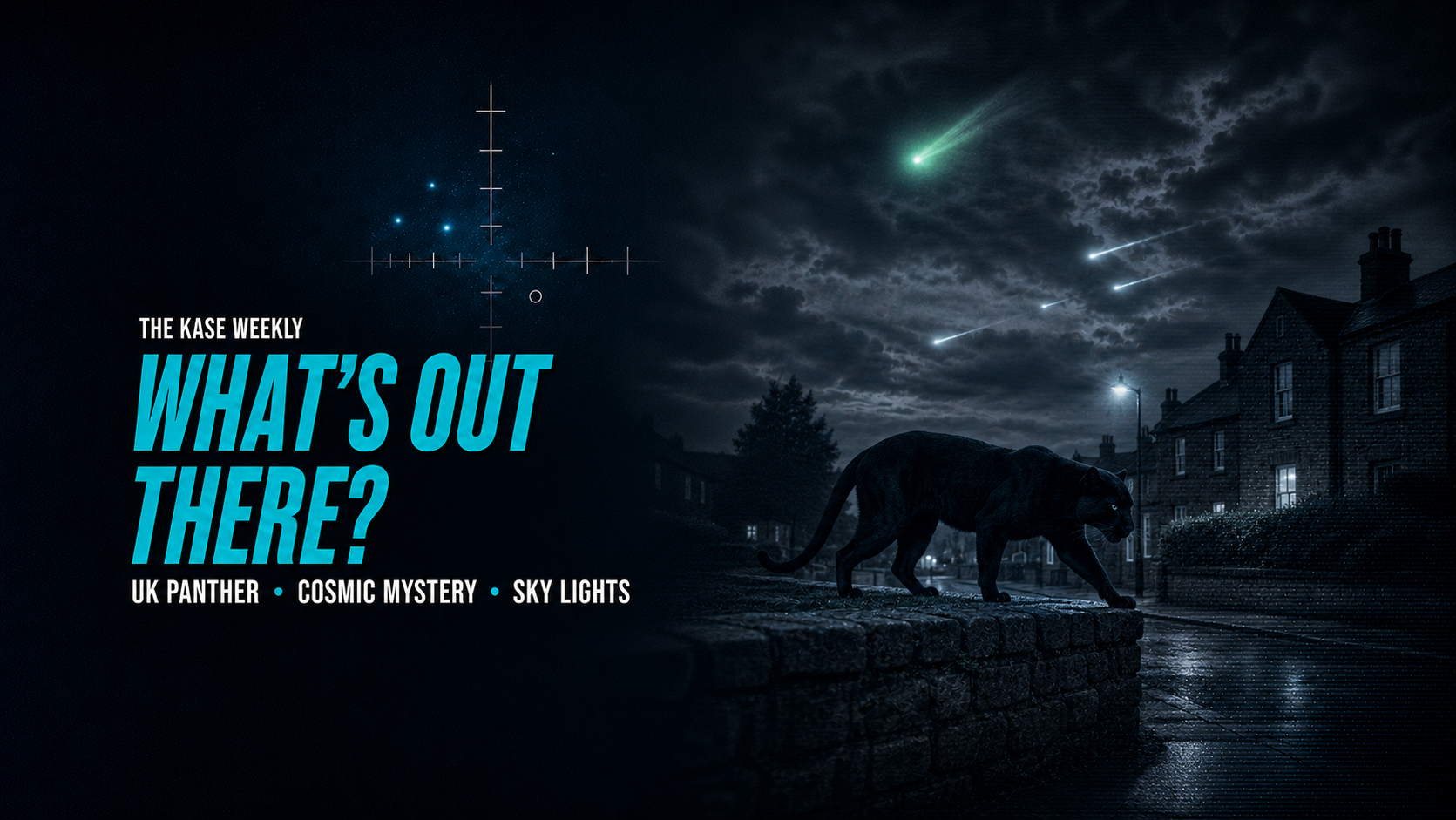
The KASE Weekly | 25-31 August 2026
This week, the unexplained ranged from a dark animal on a Northampton street to a substance hidden in the clouds of Venus.
A photograph has revived the argument over Britain's alleged big cats. Scientists have put new limits on the mysterious material absorbing sunlight in Venus's clouds. A comet has brightened dramatically twice without a confirmed cause. And in Australia, lights that looked strange enough to start an alien debate were matched to something much closer to home.
That last story matters. A mystery being solved does not make it a failed paranormal story. It shows what good investigation is supposed to do.
A Northampton photograph appears to show a large black cat
On 25 August, The Sun published a photograph taken by Clare Hodges in Ryehill, Northampton. Hodges said she saw the animal while putting out her bins on 18 August and initially thought the noise behind her was the local fox.
The image shows a dark, four-legged animal moving along a residential street. Hodges described it as a panther and said she ran back inside after taking the picture.
The report linked the photograph to two earlier claims from the wider region, near Gretton on 16 July and Deenethorpe on 6 August. Big-cat tracker Gary Ridley said members of his team were examining the image, but no independent conclusion had been published by the end of the reporting window.
What could explain it?
Britain's big-cat reports usually produce the same problem: an animal that looks impressive in one frame, but no reliable scale, sequence or physical trace to show exactly how large it was.
A large domestic cat, a dog, forced perspective or image compression all deserve consideration. The animal's apparent size is difficult to judge because the published picture does not provide a measured distance to the camera or an object beside it at the same depth.
The report also does not provide the original image file, metadata, additional frames, tracks, hair or a confirmed second witness. Those absences do not prove the animal was ordinary. They do prevent the photograph from identifying it as a panther.
The KASE take
This appears to be a genuine photograph of an animal, not evidence that a panther has been confirmed in Northampton. The useful next steps would be the original file, a daylight reconstruction from the same camera position, measured reference points and any nearby CCTV covering the animal's route.
Until then, the cat is real. Its species is the mystery.
Venus has an unknown absorber, and it is remarkably powerful
Venus looks pale yellow in visible light, but ultraviolet observations have shown moving dark markings in its upper clouds for roughly a century. Scientists know that something is absorbing ultraviolet and blue light. They still do not know exactly what it is.
A study published online in the journal Astrobiology on 25 August used observations of Venus and a radiative-transfer model to estimate how strongly the liquid inside the cloud droplets must absorb light.
The team calculated a peak absorption coefficient of about 1,278 per centimetre at a wavelength of 375 nanometres. In plain English, the mystery material must either absorb light with extraordinary efficiency, exist at a very high concentration, or do both.
The researchers found that some complex organic compounds could match part of the required optical profile. Here, "organic" means carbon-based. It does not mean alive, biological or alien.
What could explain it?
Candidates proposed over the years include compounds involving sulfur, chlorine, iron and carbon. The new model does not identify a winner. It gives each candidate a harder test to pass.
Some inorganic substances would need to make up an implausibly large share of the cloud droplets. Broad, tar-like mixtures of organics also appear to absorb too widely across the visible spectrum. A more chemically defined absorber may fit better, but that remains a model result rather than a sample from Venus.
The study depends on assumptions about cloud-particle sizes, the thickness and position of the absorbing layer, and how the unknown material is distributed. Direct sampling would be far stronger than remote observation.
The KASE take
This is a genuine scientific mystery, but it is not evidence of life in the clouds of Venus. The important development is that the list of possible explanations has become more constrained.
Good unexplained research does not simply announce that something is unknown. It defines what the unknown thing would have to be.
Comet 220P/McNaught brightened twice, and astronomers do not yet know why
Comet 220P/McNaught is normally far too faint to see without serious equipment. During 2026, it behaved rather less normally.
Observer Mike Kelley identified a major brightening in Zwicky Transient Facility data between 30 and 31 May. After fading, the comet brightened again around 5 August. By late August it had reportedly reached roughly magnitude 6, bringing it within binocular range under dark skies.
The second outburst and the comet's continuing brightness were reported within this week's window. Follow-up observations also found an unusual balance between dicarbon and cyanogen in the material around the comet, giving astronomers another clue to examine.
What could explain it?
Comet outbursts are not paranormal. Ice, dust and trapped gases can react as a comet warms, while fractures or a collapse in its surface may suddenly expose fresh material to sunlight.
The unanswered part is which mechanism caused these particular eruptions, and why the same comet produced two major events within a few months.
To answer that, astronomers need continued measurements of brightness, gas composition, dust behaviour and any structural change in the nucleus. A dramatic rise in brightness tells us that something happened. It does not, on its own, tell us what happened underneath the surface.
The KASE take
This is unresolved in the proper scientific sense. There are plausible natural mechanisms, but no confirmed mechanism for the two outbursts yet.
No aliens are required. A comet capable of changing from an obscure telescope target into the brightest comet in the sky is interesting enough without them.
Australia's strange lights were matched to satellite flares
People around Queensland had been reporting lights appearing below Venus at around 8pm. Witnesses described star-like points that appeared suddenly, moved silently, changed colour and vanished. Online explanations ranged from drones and defence testing to aliens and Australia's folkloric min min lights.
Rather than choosing the most exciting theory, a group of amateur astronomers tried to test the timing and direction of the sightings.
They worked with retired NASA aerospace engineer Philip Giacalone, who compared reports with real-time orbital data. Their conclusion was that the lights were satellite flares: sunlight reflecting from satellites in low-Earth orbit while the observer below was already in darkness.
University of Southern Queensland astrophysicist Jonti Horner supported the explanation and noted that more than 16,000 active satellites are now in orbit, alongside tens of thousands of tracked pieces of inactive hardware and debris.
Why did they look so strange?
The geometry makes the lights appear from nowhere. A satellite crosses the narrow angle where it reflects sunlight towards a particular observer, brightens briefly, then fades as it moves out of alignment.
Several satellites can produce a sequence of lights in the same area. Movement against a dark sky is also difficult to judge without fixed reference points, particularly when a witness is already trying to follow a faint object.
Not every witness was convinced, and a general explanation cannot automatically account for every separate light ever reported. In this case, however, the investigators produced a mechanism, timing data and a tool that predicts when the flares should recur.
The KASE take
This is the strongest investigation of the week because it produced a testable answer. The explanation can predict future observations instead of merely sounding plausible after the event.
It is also a useful warning for UFO investigation. As the number of satellites grows, unfamiliar lights will become more common. Checking orbital data is now part of checking the sky.
What this week tells us about unexplained evidence
The Northampton image records an animal but does not establish its size or species. The Venus study narrows a century-old chemical mystery without claiming to solve it. The comet is behaving unusually, although known natural processes remain the leading explanations. The Australian lights moved from unidentified to explained because investigators had enough timing and positional information to test them.
Four mysteries, four different evidential positions. That is why "unexplained" should describe the current state of a case, not become its permanent identity.
Which of this week's stories would you investigate first, and what single piece of evidence would you want?
The KASE Podcast lands every Tuesday. The KASE Weekly follows every Wednesday with the latest paranormal news, evidence and analysis.
Sources
- The Sun: “Panther” photographed in Ryehill, Northampton, 25 August 2026. https://www.the-sun.com/news/16897151/panther-sighting-northampton-mum-terrified/
- Astrobiology / arXiv: Spacek, Lee, Rimmer and Petkowski, “A Model of UV-Blue Absorbance in Bulk Liquid of Venusian Cloud Aerosols Is Consistent with Efficient Organic Absorbers at High Concentrations”, updated 17 August and published online 25 August 2026. https://arxiv.org/abs/2505.00880
- AlphaGalileo research release: “Venus's Mysterious Clouds May Hide an Exceptionally Strong Light Absorber”, 27 August 2026. https://www.alphagalileo.org/de-de/Item-Display-de-DE/ItemId/277306
- Futura Sciences: “This comet was nearly invisible - its sudden explosion now stuns astronomers worldwide”, 29 August 2026. https://www.futura-sciences.com/en/this-comet-was-nearly-invisible-its-sudden-explosion-now-stuns-astronomers-worldwide_38527/
- NASA Astronomy Picture of the Day: “Comet 220P in Outburst”, 24 August 2026. https://apod.nasa.gov/apod/ap260824.html
- ABC News Australia: “Hobby astronomers unite with former NASA engineer to uncover source of mysterious space lights”, 29 August 2026. https://www.abc.net.au/news/2026-08-29/astronomers-nasa-engineer-uncover-source-of-space-lights/107085630