
Paranormal News This Week: Dark Matter Signal, Saturn Decagon and 200,000 UFO Reports
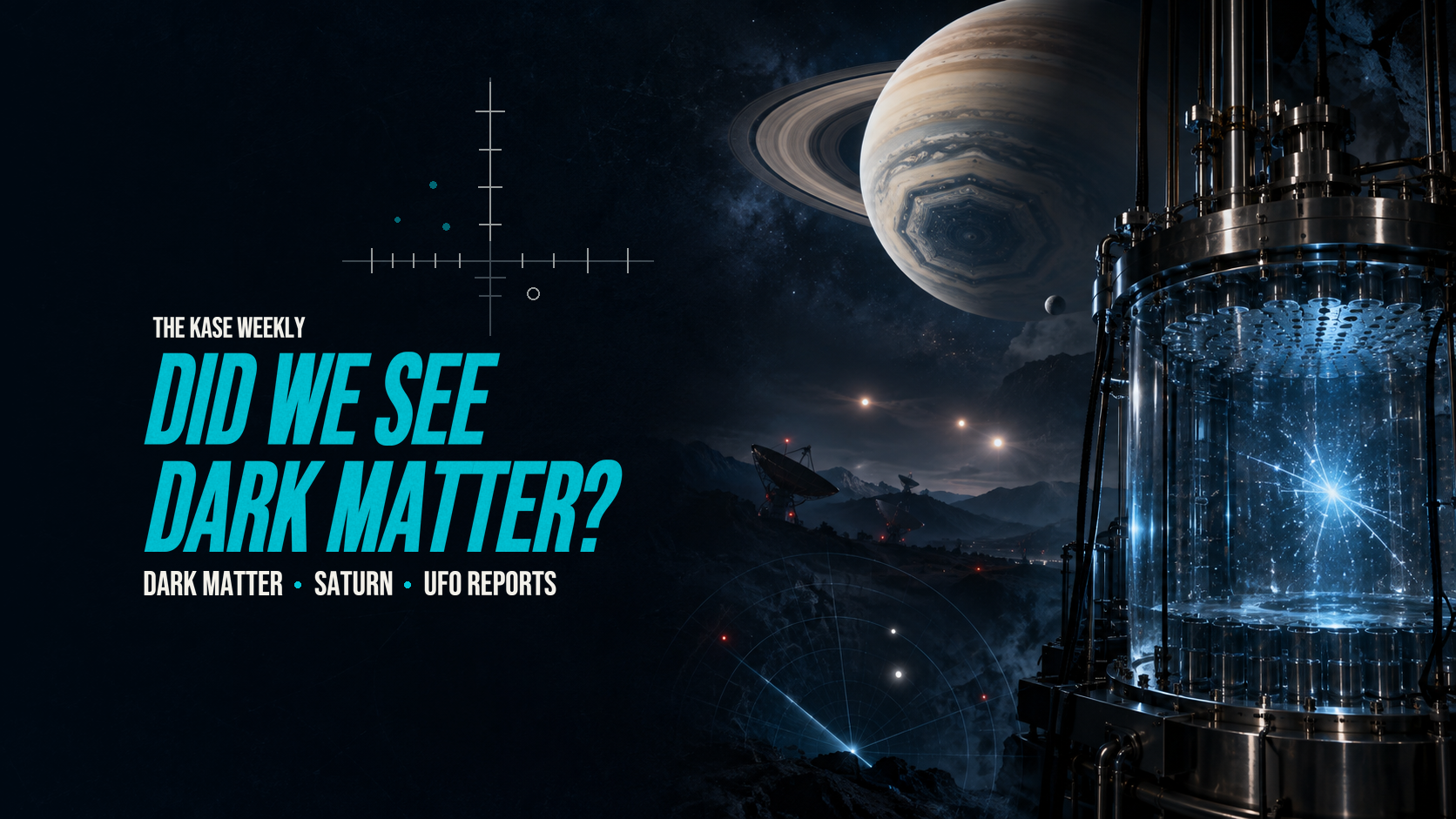
The KASE Weekly | 1-7 September 2026
This week, one particle flashed inside a detector nearly a mile underground, Saturn revealed a ten-sided pattern around its south pole, and a civilian UFO archive logged its 200,000th report.
All three stories involve something people cannot yet fully explain. They do not, however, involve the same kind of evidence.
The dark-matter result is a single instrument reading that has survived months of checks but remains far below the threshold for discovery. Saturn's decagon is unquestionably real, although the atmospheric mechanism that created it is still being studied. The UFO milestone records an enormous body of witness testimony, but a report count cannot tell us how many reports describe something genuinely anomalous.
That difference is the story this week.
Did LUX-ZEPLIN record the first hint of dark matter?
On 1 September, the LUX-ZEPLIN collaboration announced that its detector had recorded one particle interaction that researchers have struggled to explain through known background processes.
LUX-ZEPLIN, usually shortened to LZ, sits nearly a mile underground at the Sanford Underground Research Facility in South Dakota. Its central detector contains ten tonnes of extremely pure liquid xenon. If a particle collides with a xenon atom, the interaction can produce tiny flashes of light and electrons for the detector's sensors to record.
The experiment is searching for weakly interacting massive particles, or WIMPs, one of the leading proposed explanations for dark matter. We can observe dark matter's gravitational effects on galaxies and galaxy clusters, but no experiment has yet identified what it is made from.
The new analysis examined 220 live days of data collected between March 2023 and April 2024. It found one event in a region where the detector expected very little interference from ordinary background sources.
The result reached 2.6 sigma. In the collaboration's analysis, that corresponds to roughly a 0.5 per cent chance that known backgrounds produced the event. Particle physics normally requires five sigma before a discovery is claimed, and the researchers have been unusually clear that one intriguing event is not a dark-matter detection.
There is another complication. If the event came from a WIMP, it would not fit the simplest model of how WIMPs should interact with ordinary matter. It would require a heavier particle, probably more than 200 times the mass of a proton, and a less straightforward form of scattering.
What could explain it?
The exciting possibility is that a dark-matter particle struck a xenon atom and produced the first direct glimpse of matter that has remained invisible for decades.
The less cinematic possibilities include an exceptionally rare background interaction, a physical process the model does not yet include, or a statistical outlier that looks more important because only one event was recorded.
The collaboration has already examined the obvious detector and background explanations. That makes the event interesting. It does not make every unknown cause a WIMP by elimination.
The next test is repetition. LZ has continued collecting data, and a genuine particle population should produce more events with a consistent energy pattern. If the significance grows as more data are added, the case strengthens. If it fades, this may become a fascinating dot in a much larger graph.
The KASE take
This is the strongest evidence story of the week because the instrument, analysis and uncertainty are all open to scientific challenge.
It is also an excellent example of why researchers are more cautious than headlines. LZ has not found dark matter. It has found one event that has not yet surrendered an ordinary explanation.
That may become historic. For now, it is a very expensive and extremely well-monitored mystery flash.
Saturn has developed a giant ten-sided atmospheric wave
Saturn's north pole has been famous for its hexagon since NASA's Voyager spacecraft observed it in the early 1980s. Now the planet appears to have another geometric curiosity.
Research published in Science Advances and announced by NASA and the European Space Agency during this reporting window describes a huge ten-sided atmospheric wave surrounding Saturn's south pole.
The decagon is centred at roughly 63 degrees south and sits within one of the planet's powerful jet streams. Its diameter is about 168,000 kilometres, with each side stretching for more than 16,000 kilometres. Earth would fit inside it rather comfortably, which feels unnecessarily showy even by Saturn's standards.
The feature appears in several wavelengths of Hubble data, showing that it extends through multiple levels of the atmosphere. Researchers traced faint signs of it to observations from 2023, while images from 2025 show the ten-sided pattern more clearly.
It was not visible in older Cassini observations, although Saturn's changing seasons and viewing angle limited what could be seen from Earth for part of that period. Scientists therefore think they may be watching a large planetary wave emerge and strengthen in real time.
What could explain it?
Despite its improbable geometry, the decagon is not a solid structure and nobody has built a ten-sided platform over Saturn.
The leading explanation is a large atmospheric wave trapped within a fast-moving jet stream. Differences in wind speed, latitude and the planet's rapid rotation can force a flowing band of gas into a repeating polygonal shape. Similar fluid behaviour has been reproduced in laboratory experiments, and related waves occur in planetary atmospheres.
What scientists do not yet know is why Saturn produces such enormous, regular shapes, why the southern feature has ten sides rather than six, how deep the wave reaches, and whether it will stabilise like the northern hexagon or disappear as conditions change.
The decagon also shifts slightly depending on the wavelength used to observe it. That suggests different atmospheric layers may not be perfectly aligned, giving researchers a way to probe its three-dimensional structure.
The KASE take
The shape is real. The mystery lies in the mechanism and timing, not in whether Hubble photographed it.
This is what a healthy unexplained story looks like. There is excellent evidence for the observation, a plausible physical framework, and specific questions that future measurements can answer.
Saturn has not sent us a coded ten-sided warning. It has produced weather on a scale and in a shape that Earth's atmosphere has the good manners to avoid.
NUFORC has logged its 200,000th UFO report
On 7 September, the National UFO Reporting Center announced that it had received its 200,000th sighting report during August.
NUFORC has collected civilian accounts for 52 years, beginning with handwritten reports stored in a filing cabinet and developing into a searchable online archive containing submissions from every US state and many other countries.
The organisation says nearly 2,000 reports submitted during the past four years appear in its highest-priority Tier 1 category. These include accounts of close structured objects, silent triangles, unusual lights and apparently extraordinary movement.
The milestone arrived during a wider argument about who is responsible for recording civilian UAP sightings. The Pentagon's All-domain Anomaly Resolution Office, or AARO, states that it is not currently accepting general sighting reports directly from the public. Civilian pilots are directed through aviation reporting channels, while most other witnesses rely on private databases such as NUFORC and MUFON.
That makes the archive valuable. It preserves testimony that might otherwise disappear and allows researchers to search for repeated locations, times, shapes and descriptions.
It does not mean Earth has now received 200,000 confirmed alien visits.
What can a report database actually prove?
A sighting report proves that a person submitted an account. It may also preserve useful details such as the time, direction, weather, photographs, video or an independent witness statement.
It cannot establish the identity of an object without investigation. The archive inevitably includes aircraft, satellites, planets, balloons, drones, atmospheric effects, camera artefacts, hoaxes and honest mistakes alongside cases that remain genuinely unresolved.
NUFORC's own milestone article goes further than its data can support by arguing that its reports show non-human intelligences making regular appearances on Earth. That conclusion may reflect the organisation's interpretation, but it is not produced automatically by the size of the database or by labelling selected entries Tier 1.
Tier labels are screening judgements, not laboratory results. The strongest cases would need original files, precise locations, sensor data, aviation and satellite checks, witness interviews and a transparent explanation of how competing hypotheses were excluded.
There is also a difference between the government not offering a direct public submission form and the government ignoring civilian data entirely. AARO sponsored a 2025 workshop on UAP narrative data that included participants from government, academia and independent research organisations. That does not resolve the reporting gap, but it complicates the claim that nobody official is looking.
The KASE take
Two hundred thousand reports are not proof of one explanation. They are evidence of the scale, persistence and human importance of the UFO question.
The archive's greatest value is not that it can win the alien argument by volume. It is that large, searchable datasets can reveal patterns and allow individual claims to be checked against ordinary activity.
The next useful step would be a published methodology showing how reports are screened, investigated and upgraded, together with a clear route for sharing high-quality civilian cases with official analysts without exposing witnesses unnecessarily.
Counting the unknown is worthwhile. We still have to investigate what each number represents.
What this week tells us about unexplained evidence
The LZ event is one unusual instrument reading inside a carefully controlled experiment. Saturn's decagon is a confirmed observation with an incomplete physical explanation. NUFORC's milestone is a vast collection of human testimony whose individual evidential quality varies enormously.
One may disappear into the background as more data arrive. One is unquestionably present but still forming. One contains cases ranging from readily explainable to genuinely difficult.
They are all worth examining. None earns a conclusion simply by being strange.
Which would you investigate first: the particle beneath South Dakota, the ten-sided wave on Saturn, or the strongest case hidden somewhere among 200,000 UFO reports? What evidence would you need before changing your mind?
The KASE Podcast lands every Tuesday. The KASE Weekly follows every Wednesday with the latest paranormal news, evidence and analysis.
Sources
Lawrence Berkeley National Laboratory, “LZ Sees Surprising Result in Search for Dark Matter”, 1 September 2026. https://newscenter.lbl.gov/2026/09/01/lz-sees-surprising-result-in-search-for-dark-matter/
Brown University, “LZ experiment sees surprising result in search for dark matter”, 1 September 2026. https://www.brown.edu/news/2026-09-01/lz-dark-matter-results
NASA, “NASA's Hubble Tracks New Decagon Encircling Saturn's South Pole”, updated 4 September 2026. https://science.nasa.gov/missions/hubble/nasas-hubble-tracks-new-decagon-encircling-saturns-south-pole/
Sánchez-Lavega et al., “A decagon wave around Saturn's south pole”, Science Advances, 2 September 2026. https://www.science.org/doi/10.1126/sciadv.aee4251
European Space Agency, “Hubble tracks new decagon encircling Saturn's south pole”, 2 September 2026. https://www.esa.int/Science_Exploration/Space_Science/Hubble_tracks_new_decagon_encircling_Saturn_s_south_pole
National UFO Reporting Center, “NUFORC Logs its 200,000th UFO Report”, 7 September 2026. https://nuforc.org/nuforc-logs-its-200000th-ufo-report/
All-domain Anomaly Resolution Office, “Submit A Report”, accessed 8 September 2026. https://www.aaro.mil/Submit-A-Report/
All-domain Anomaly Resolution Office, “2025 UAP Workshop: Narrative Data, Infrastructures, and Analysis”, accessed 8 September 2026. https://www.aaro.mil/UAP-Records/