
Paranormal News This Week: Missing UFO Videos, Live Alien Claims and New Nessie Sightings
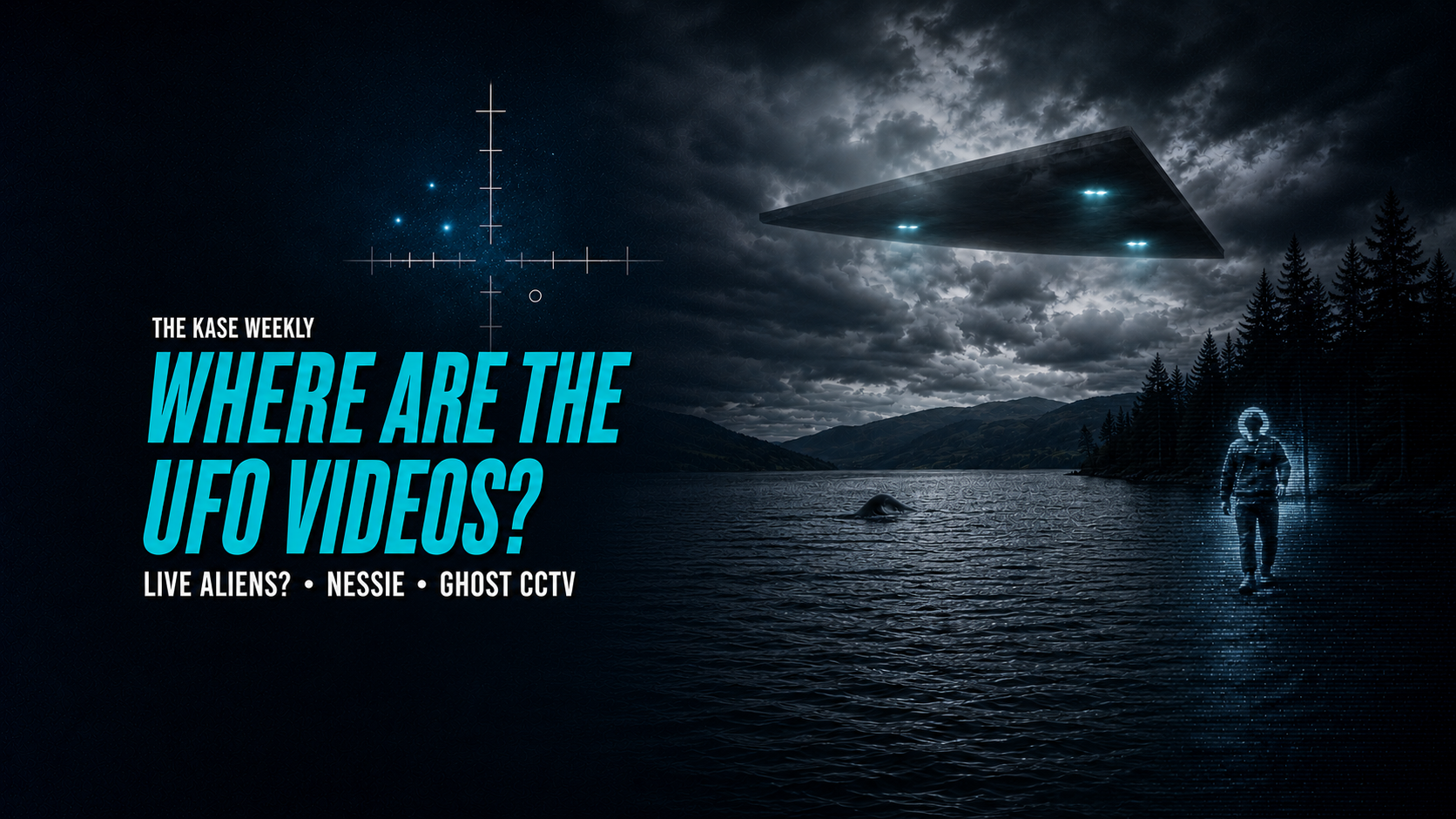
The KASE Weekly | 11-17 August 2026
The paranormal has had another busy week, and American UFO disclosure has chosen chaos.
US officials say they are now looking for two allegedly classified videos of a huge triangular object over a Colorado military base. Former intelligence officer David Grusch says live non-human beings were detained and communicated through consciousness. The Loch Ness sightings register has already overtaken its total for the whole of 2025. Meanwhile, Medellin produced two viral videos in which things apparently vanished into thin air.
Those stories may all sit under the broad paranormal umbrella, but they do not sit on the same evidential shelf. One concerns footage that may exist but has not been released. One is an extraordinary second-hand claim without public evidence. One is a cluster of witness reports and ambiguous photographs. Two are short viral clips whose technical history is largely unknown.
That difference is the story this week.
KASE believes genuinely unexplained events deserve serious attention. That is precisely why we separate what has been reported from what has been demonstrated, and why the words 'we do not know yet' remain more useful than a conclusion the evidence has not earned.
The Pentagon is looking for two alleged triangle UFO videos
On 15 August, the New York Post reported that the US Department of War was trying to establish the whereabouts of two videos said to show a roughly 100-foot triangular object near a military base in Colorado.
The paper says the clips were recorded on a service member's personal phone on consecutive nights in 2023. Unnamed sources described an object moving over mountains and appearing to use cloud cover. They also supplied two Air Force Office of Special Investigations file numbers: IRR1669S015524 and IRR1669S005024.
Acting press secretary Joel Valdez then wrote publicly that his team was looking into the report and that anything uncovered would be released through the government's PURSUE archive.
That is a real and relevant development. It is not, however, confirmation that the videos have been found, that the file numbers are authentic, or that the clips show an anomalous craft. The government has confirmed the search, not the object.
The distinction matters because the description currently comes from unnamed sources who say they know the footage. The public cannot yet check the videos, their metadata, their location, the service member's account or the circumstances in which the files were obtained and classified.
How this connects to the files released last week
The allegation arrived just after the fifth release on the official PURSUE UAP archive, which included two FBI interview records concerning separate triangular objects reportedly seen around Colorado Springs in October 2023.
In one released FBI interview record, a witness described a very large black equilateral triangle with a red light at each corner. The object was said to be silent, to accelerate rapidly and to bank in an unusual way. The interview was recorded in 2025 about an alleged sighting in 2023.
The accompanying image is an artistic reconstruction, not a photograph. The released report records what the witness told FBI agents. It does not independently establish the object's size, speed or origin.
The newly alleged phone videos may relate to the same general period and state, but the public material does not establish that they show either of the two released Colorado Springs cases. Similar descriptions are not enough to join separate records into one event.
What would make the footage useful?
If the clips are located and released, the most valuable material will not be the most dramatic frame. Researchers would need the original files rather than a social-media copy, together with their metadata, the exact time and location, the witness's position and line of sight, nearby flight activity, weather and cloud information, radar data if it exists, and a documented chain of custody.
Two recordings on consecutive nights could be unusually valuable because repeated observations allow comparison. They could also point towards a recurring conventional source, such as aircraft activity, training, drones or a viewing geometry specific to that location. Repetition strengthens an investigation only when the conditions are documented well enough to compare.
The KASE take
This is worth following because a named government spokesperson has committed the department to looking for the records. That moves the story beyond a completely unsupported internet rumour.
It still leaves us several steps short of confirming what the footage shows. Missing evidence is not automatically proof of a cover-up, and a search for a file is not validation of every claim attached to it.
If the original clips emerge with usable context, this could become one of the more interesting recent UAP cases. Until then, the most accurate headline is also the least cinematic: the US government is looking for two alleged videos.
Then David Grusch said live aliens had been detained
The same week produced a much larger claim. In an interview on The Dr. Phil Podcast, former US intelligence officer David Grusch said he knew people who had direct interactions in what he called a 'detainment situation' involving non-human beings.
Grusch also said he had spoken to a former cabinet member who worked on the issue for a former vice president he jokingly described as 'Darth Vader', widely understood as a reference to Dick Cheney. He claimed communication with the alleged beings took place through consciousness, commonly described as telepathy, and suggested the US may possess between 25 and 100 recovered craft.
Grusch is not an anonymous social-media account. He previously served in intelligence roles and testified at a US congressional hearing in 2023 about alleged crash-retrieval and reverse-engineering programmes. His background is relevant because it may have given him access to people and records unavailable to the public.
Credentials, however, are not transferable proof. A person's professional history can help us judge whether they may have been in a position to hear a claim. It cannot establish that the claim itself is true.
What is publicly testable?
At present, the live-being claim reaches the public through several layers. Grusch says unnamed people had direct interactions. He says an unnamed former cabinet member discussed work connected to an unnamed programme. The alleged locations, dates, biological material, records and participants have not been made public.
That does not prove the account is false. Intelligence sources may face genuine legal, professional or security restrictions. It does mean the public cannot independently test the claim, and the more extraordinary details currently rest on authority and trust rather than inspectable evidence.
There is also an important difference between testimony about what someone personally observed and testimony about what other people reported. Hearsay can lead investigators towards evidence. It is not a substitute for that evidence.
The claim would move forward if named first-hand witnesses testified through protected channels, if relevant inspectors general or congressional committees confirmed programme records, if budgets and documents could be authenticated, or if physical and biological material were made available to independent experts under a secure chain of custody.
The KASE take
This is the most extraordinary claim of the week and, publicly, the least testable. It should not be dismissed simply because it sounds impossible, but it should not be promoted as established fact simply because the speaker once held a security clearance.
Government secrecy is real. Whistleblowers can also be sincere. Neither fact guarantees that every account passed through a classified environment is accurate, complete or free from misinformation.
A serious-looking studio is not a chain of custody. Until evidence is produced that independent people can examine, live telepathic aliens remain a claim, not a disclosure.
Nessie is having a busier year
Back in Britain, the Official Loch Ness Monster Sightings Register now lists nine in-person reports for 2026. That is already more than the six logged during all of 2025 and the three recorded in 2024. The current modern high remains ten reports in 2023.
Three of this year's most recent entries came in July. An eight-year-old girl and her family reported a dark object they estimated at around six feet long. A visitor from Australia described a dark green, flat-topped head followed by two humps and what he interpreted as a tail movement. Two days later, a nine-year-old Australian visitor photographed what she believed was the head of a creature from the lower deck of a cruise boat.
The photographs are interesting in the proper meaning of that word: they give us something to examine. They are also distant, low-detail images of objects at the surface of a vast body of water. None shows enough anatomical detail to identify an unknown animal, and the register describes them as reports of something unexplained rather than confirmed monster encounters.
Does a rise in reports mean a rise in activity?
Possibly, but it could also reflect how many people visited the loch, how much time they spent watching the water, the number of cameras available, publicity surrounding earlier reports and the ease of submitting a sighting. A reporting total measures accepted reports. It does not directly measure the number of unknown animals in the water.
Clusters can still be useful. Multiple observers describing similar features may reveal a recurring biological or environmental cause. They may also show how expectation influences what people notice and how they describe it. Both possibilities deserve investigation.
Boat wakes can travel far from the vessel that created them and may form several apparent humps. Birds, seals, eels, logs and changes in light can all create convincing shapes, particularly when distance removes scale and detail. Those are hypotheses to test against each report, not a single explanation that can be pasted over every sighting.
A major environmental DNA survey led by the University of Otago found abundant eel DNA throughout the loch but no evidence supporting a large reptile or plesiosaur. The researchers noted that DNA could not reveal the size of the eels sampled, so an unusually large eel could not be completely excluded. The study did not discover a monster-sized eel; it found ordinary eel DNA in many locations and left body size unresolved.
What would make a Nessie report stronger?
The original unedited photographs or video should be preserved with timestamps and metadata. Investigators would want the exact viewpoint and camera direction, lens or zoom setting, weather and water conditions, nearby boat movements, consecutive frames before and after the object appeared, and statements taken independently from each witness.
A photograph with a known object at the same distance would help establish scale. Simultaneous footage from a second position would help establish location and movement. Sonar corresponding to the same time and place would add a separate evidential layer. A single photograph can be intriguing; several independent forms of data are much harder to misread in the same way.
The KASE take
Nessie has not broken cover, but she has broken last year's reporting total.
Nine entries show that people are still seeing things at Loch Ness that they cannot immediately identify. They do not show that nine people saw the same creature, or that an unknown species has been established.
The recent photographs deserve calm analysis in their original form. The mystery becomes more interesting, not less, when we distinguish a real unexplained observation from a confirmed monster.
Medellin produced two disappearing acts
Two short clips from Medellin, Colombia, circulated through paranormal media this week. In the first, filmed late in July, a white circular object appears to hover in the sky before vanishing abruptly. Witnesses react in surprise. Some viewers proposed cloaking technology, while others suggested a balloon popping.
In the second clip, a nearly transparent figure walks across an apartment-complex car park, passes behind a concrete column, appears to emerge carrying a broom, then gradually blends into the background. Security staff reportedly noticed it while monitoring the camera.
The broom is an unexpectedly practical accessory for an apparition. It is also a useful clue that the camera may have recorded an ordinary person, possibly a cleaner or worker, under conditions that made movement look transparent.
Why cameras make people disappear
Cameras do not record reality neutrally. A phone filming a small bright object against the sky may lose focus or exposure at the moment the object changes, turns, deflates or bursts. Social-media compression can remove the few pixels that distinguished it from the background. A cut or missing frames can create the same effect, whether deliberate or accidental.
Low-light security footage has its own problems. Surveillance-camera manufacturer Axis explains that cameras often use a longer shutter time in poor light so the sensor can gather enough information. A moving person can then become blurred or smeared across frames. The company's guide describes motion blur as a predictable side effect of low-light exposure.
Noise reduction and video compression can make that effect stranger. Static backgrounds are preserved efficiently while a moving subject is averaged, broken into blocks or allowed to fade into similar colours. Passing behind a column gives the system an additional moment to lose or reconstruct parts of the figure.
This does not prove either Colombian clip has an ordinary explanation. We have not been given the raw files, camera specifications, complete recording or a controlled recreation. It does show why 'it vanished on camera' is a description of the footage, not yet an explanation of the event.
What would we ask for?
For the sky video, we would want the original phone file, its full duration, metadata, the exact position and direction, statements from each witness and any other recordings from the area. For the CCTV clip, we would want the direct export rather than a phone recording of a monitor, the camera model and settings, footage from at least several minutes before and after, information about staff movements, and comparison footage of a person walking the same route in the same light.
Until those materials are available, both clips belong in the category of interesting but under-documented. Their strongest feature is visual drama. Their weakest is provenance.
The KASE take
Medellin probably did not become home to both a cloaked aircraft and a spectral cleaner in the same fortnight.
The two clips may have unrelated ordinary causes, unrelated anomalous causes or different mixtures of event and camera artefact. Their shared location became a pattern only after media outlets placed them side by side.
Viral video is evidence of what a particular file appears to show. Without the original file and its context, it is rarely enough to establish what happened in front of the camera.
Tragedy is not proof of a curse
The most serious paranormal story of the week concerns Chinese creator Jiang Xiaorou, who built an audience of more than one million followers through ghost-hunting and anti-superstition videos. She died on 10 August, aged 24, after suffering severe injuries in a road collision on 15 July. On 11 August, her family asked the public to stop unverified discussion and excessive speculation.
A video from 2025 then resurfaced in which Jiang smashed a statue of Guanyin, a Buddhist figure associated with compassion and mercy, and challenged the idea that she would face supernatural punishment. Some social-media users presented her later death as karma or a curse.
The original stunt can reasonably be regarded as disrespectful. Her death still does not demonstrate divine or paranormal retaliation.
The timing creates a powerful story because people naturally connect a memorable earlier act with a later tragedy. The difficulty is that the connection was drawn after the event. No mechanism was shown, no time limit was predicted and no outcome was specified in advance. A road collision already has a physical chain of events to investigate.
If every tragedy following a provocative statement is counted as supernatural punishment, while the vastly larger number of provocative statements not followed by tragedy are ignored, the conclusion cannot be fairly tested. It becomes a story that can only confirm itself.
Jiang's family explicitly asked people to respect the facts and her privacy. That request should carry more weight than the engagement value of a curse headline. A fuller English-language account of the family's statement is available through People.
The KASE take
We can respect spiritual and religious traditions without using a young woman's death as proof that she deserved punishment.
Paranormal belief should never remove compassion. In a field that asks whether consciousness survives death, the least we can do is remember the person rather than turn the death into a prop for whichever conclusion we already preferred.
KASE will not present this accident as evidence of a curse. The responsible position is simple: the cause of the collision belongs to the factual investigation, and the family's request for dignity should be respected.
What this week tells us about paranormal evidence
The most dramatic claim is not always the strongest, and evidence cannot be ranked by how exciting the headline sounds.
The alleged Colorado videos: Potentially testable evidence may exist, but the files have not been released or independently authenticated.
The live-alien claim: A named former official has made an extraordinary statement, but the public account remains several layers removed from first-hand evidence.
The Nessie reports: Multiple witness accounts and photographs exist, but the images remain ambiguous and ordinary explanations have not been excluded.
The Medellin clips: Visual files exist, but their provenance, raw data and recording conditions are missing.
The curse narrative: A real tragedy has been linked retrospectively to an earlier stunt without a method capable of testing supernatural causation.
These distinctions are not designed to drain the mystery from paranormal news. They prevent very different kinds of material from being flattened into the same word: proof.
The Colorado footage could still emerge. Grusch's sources could still testify or produce records. Better copies of the Nessie photographs could reveal useful details. Original Medellin files could allow a proper technical analysis. Evidence can change, and our conclusions should be allowed to change with it.
Until then, we stay interested without pretending uncertainty has already chosen a side.
Which story deserves a full KASE deep dive: the missing Colorado videos, David Grusch's live-being claims, the new Nessie photographs or the Medellin footage? Tell us what you think, and what evidence might change your mind.
The KASE Files podcast lands every Tuesday. The KASE Weekly follows every Wednesday with the strangest news from the previous seven days.