
Paranormal News This Week: Pentagon UFO Files, Bigfoot DNA and Ghosts at Clacton Pier
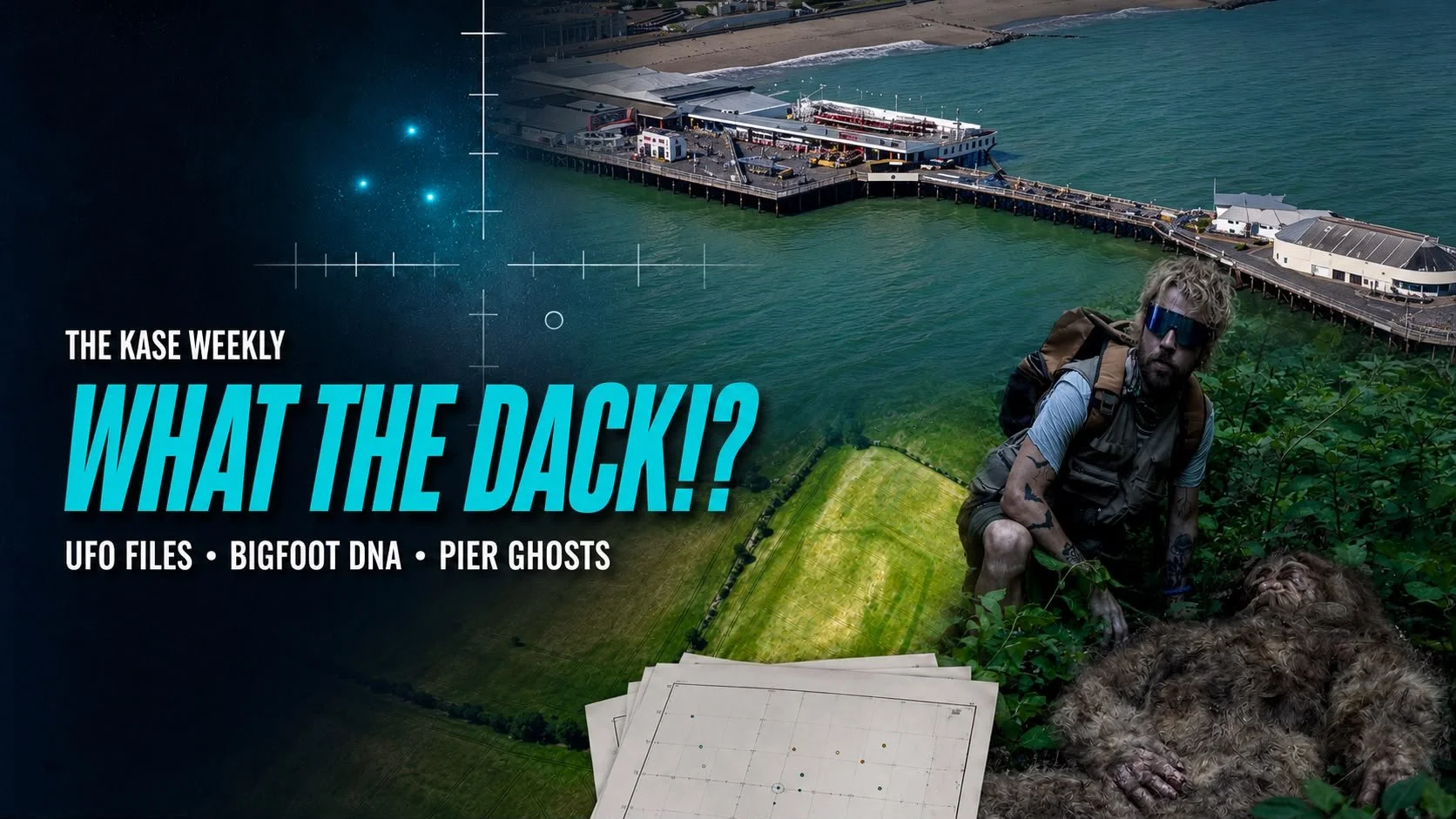
The KASE Weekly | 4-10 August 2026
The paranormal has had a busy week.
The Pentagon released 41 more UAP files. A Bigfoot researcher threatened to sue Cornell University over DNA results attributed to an alleged body called Dack. Researchers asked more than 5,000 people what extraordinary experiences actually do to us. And an Essex pier announced significant spirit activity inside a Victorian theatre that is due to become a Halloween attraction in October.
Official secrecy, disputed DNA, human consciousness and a theatre at the end of a pier: it is a surprisingly complete cross-section of the modern paranormal field.
Welcome to the first edition of The KASE Weekly, our new round-up of paranormal news, unusual research and strange claims from around the world.
KASE usually works closer to home through our free and confidential private paranormal investigations across Kent and the South East: https://www.kaseparanormal.co.uk/private-investigations. The unexplained, however, has never shown much respect for county boundaries.
Most of us at KASE believe paranormal activity is real, even if we do not all agree on exactly what it is or how it works. We are also highly sceptical investigators. Those positions are not opposites. Believing that genuinely unexplained events occur gives us more reason to separate them from misidentification, contamination, coincidence and claims that have travelled further than their evidence.
Each week, we will look at what has been reported, what the evidence can support, what ordinary explanations deserve consideration and which mysteries are genuinely worth watching. Belief will never be the punchline, but mystery will not be used as a shortcut around evidence either. When the honest answer is "We do not know yet," that is where the interesting work begins.
The Pentagon releases 41 UAP files, and some are genuinely odd
On 7 August, the US Department of War published its fifth release of declassified and historical UAP material. The 41 files reportedly draw on material from the Pentagon, FBI, CIA, State Department and the Executive Office of the President, with records spanning from 1950 to 2026.
The Pentagon has released files, not answers. The paperwork may be less dramatic than the footage, but in a field where context is so often missing, the paperwork matters.
There is a lot in the release, but two cases have attracted most of the attention.
The first comes from a US military exercise over the Gulf of Oman in September 2021. According to an accompanying intelligence report, personnel aboard an AC-130J gunship observed approximately 25 instances of objects described as "cold orbs" on infrared and thermal sensors. The report described apparent speeds between 250 and 1,300 mph, different formations, aggressive manoeuvring and objects that seemed to react when the aircraft fired its main cannon.
The available footage is intriguing. It is also grainy, limited and missing much of the information needed to test the more dramatic interpretations. "Cold" in this context describes the object's appearance relative to its surroundings on a thermal display. It is a sensor description, not a direct measurement of the object's physical temperature. Even official terminology can sound more conclusive than it really is.
The second case is a witness account from Bagram Airfield in Afghanistan in 2002. A former military pilot told investigators that something enormous and apparently triangular passed overhead in silence, blocking out the stars. An artist later produced an image based on the account.
That distinction is important. The image is a reconstruction of a witness description, not a photograph of the object. A government file confirms that a report was recorded. It does not automatically confirm that every detail in the report represents an unknown craft.
CBS News has a useful overview of the newly released cases and footage: https://www.cbsnews.com/news/ufo-files-pentagon-5th-release-documents-videos/.
So what could the objects have been?
Several theories remain in play.
They could include conventional objects such as drones, balloons or other aircraft seen under difficult conditions. They could involve classified technology that the people reviewing the files were not cleared to identify. Some of the apparent movement could be affected by sensor behaviour, tracking errors or parallax, where an object's speed and direction look very different because the observer is moving and the distance is uncertain.
There is also the possibility that at least some cases represent a genuinely unfamiliar phenomenon. That possibility is exactly why the files deserve serious attention.
Non-human technology remains one possible interpretation. There is nothing inherently unserious about considering it, but it is a conclusion the data must earn. At present, the public material leaves that question open.
To go further, independent analysts would need original-quality footage, timestamps, sensor specifications, range estimates, aircraft movement, weather conditions, radar data and the full analytical trail. Without those, a reported speed of 1,300 mph may be extraordinary, or it may be the result of uncertain geometry. Precision in a report is only as strong as the measurements beneath it.
The KASE take
This is worth watching. The military context, multiple reported observations and sensor records give the Gulf of Oman material evidential layers that many sightings do not have.
But "unresolved" is an honest status, not a conclusion. It does not mean unimportant, and it does not mean extraterrestrial. It means the evidence available has not produced a confident identification. That is not a disappointing answer. It is the point at which proper inquiry begins.
As we explain in our guide to how paranormal investigation works and what good evidence looks like - an anomaly becomes useful when the wider context can be checked. The Pentagon has given the public more material. Now it needs to give researchers enough context to do something meaningful with it.
The alleged Bigfoot body that Cornell says it never tested
Charles Stuart, who calls himself "Snake the Bigfoot Hunter", says he found the decomposing body of an eight-foot, 300-pound creature in New York's Adirondack Mountains in 2024. He named it Dack and has displayed the alleged remains publicly.
Stuart later claimed that DNA testing conducted through Cornell University's veterinary laboratory showed Dack to be 58.5 per cent Neanderthal and 41.5 per cent human.
Those figures are strikingly precise, but precision is not the same as transparency. Without the methods, raw sequencing data and independent replication, the percentages cannot be meaningfully assessed.
There is, however, a fairly substantial problem. Cornell told the press that it did not conduct the testing or produce the report. The university also said the documents being presented as its work did not come from Cornell.
Stuart's response was not to withdraw the claim. He accused Cornell of participating in a cover-up, promised a documentary featuring an alleged whistleblower from the laboratory and has now reportedly threatened a $10 million lawsuit: https://www.telegraph.co.uk/us/news/2026/08/07/cornell-university-bigfoot-dna-lawsuit/.
We therefore have several possible scenarios.
One is that Stuart really possesses the body of an unknown hominin and a major university is denying world-changing results. Another is that a sample was tested somewhere, but its origin, analysis or connection to Cornell has been misrepresented. A third is that the specimen and report are not what Stuart says they are.
These possibilities do not currently carry equal evidential weight. Cornell's denial is public and attributable, while Stuart's claimed results have not been independently verified. An examination of the specimen by outside experts would ultimately tell us more than an exchange of statements can.
What would convincing evidence look like?
An alleged Bigfoot body is not a blurry photograph or a footprint in mud. If a physical specimen exists, the claim is unusually testable. Researchers would need:
Tissue collected under an independently documented chain of custody
Testing by several accredited laboratories with no connection to the claimant
Raw sequencing data, methods, contamination controls and named analysts
CT scans, anatomical examination and clear high-resolution documentation
Access for qualified geneticists, pathologists, primatologists and anthropologists
Results that can be repeated by researchers who are free to disagree
Until that happens, "Cornell is denying it" is not evidence that Cornell tested it.
There is also a problem of falsifiability. If Cornell confirms the report, that supports Stuart's account. If Cornell denies it and the denial is treated as proof of a cover-up, the claim begins to form a closed loop. Once every possible response supports the same conclusion, the evidence can no longer test it fairly.
There is also a publicity context. Dack has been displayed at the New York State Fair and is expected to return. That does not prove the specimen is false. Publicity and genuine discoveries can coexist. It does mean that independent verification matters even more, particularly when a sensational claim is also an attraction.
The KASE take
We would love a properly authenticated cryptid discovery. The possibility of an unknown primate or surviving hominin is precisely why a physical specimen deserves serious attention. If genuine, it would transform biology, anthropology and our understanding of human history.
That is precisely why the standard of evidence must be high.
Science is often at its most convincing when it is least cinematic. A discovery capable of rewriting human evolution would eventually have to spend a great deal of time in fairly unglamorous rooms, being labelled, sampled and checked by experts with no stake in the outcome. That is not bureaucracy getting in the way of discovery. It is how an extraordinary specimen becomes a scientific fact.
Until independent experts can examine Dack and reproduce the claimed findings, this remains an extraordinary and testable claim rather than established evidence.
A major study asks what extraordinary experiences do to people
The most important paranormal story of the week may also be the least theatrical.
A peer-reviewed study published in PLOS ONE on 5 August examined how people understand and respond to what the researchers call "nonordinary experiences". These included experiences such as sensing a presence, unexplained sounds or touch, visions, out-of-body experiences and near-death experiences.
The study, titled Making Sense of the Extraordinary - first tested and refined its questions with 160 Brazilian adults. The researchers then surveyed 5,117 people from the Brazilian general population, with each participant reporting on one of 38 types of experience.
The findings are fascinating:
51 per cent said the experience had produced positive long-term effects
20 per cent reported an immediate negative impact
25 per cent reported some degree of suffering or discomfort
Around 57 per cent said they were awake and alert
Around 39 per cent were alone when it happened
Many participants did not believe that a specific being or agent caused the experience, and chance was a common explanation. Others interpreted similar experiences through religious, spiritual or paranormal ideas.
The study neither proves nor disproves that ghosts, spirits or other paranormal causes produced any of these events. It was not designed to answer that question. It studied the experience, the circumstances around it and the meaning people later gave it.
That separation is extremely useful.
An experience can be genuine, profound and life-changing while its cause remains open. Taking the person seriously and keeping the explanation under investigation are not contradictory positions.
Why interpretation matters
The research suggests that the way people understand an extraordinary experience may help shape whether it becomes distressing, meaningful or even positive over time.
This has an obvious lesson for paranormal investigators. Mocking someone can leave them isolated. Telling a frightened person that they definitely have a demon can make an uncertain situation far worse. Calm listening, practical checks and room for more than one explanation can help people process what happened without forcing them into either belief or disbelief.
Taking someone seriously does not require us to certify their first theory. Offering ordinary possibilities does not require us to dismiss what they felt.
The study has limitations. Each participant reported on only one experience. The answers were closed-ended, the sample was more highly educated than the wider population, and everyone was surveyed within one national and cultural setting. It also relies on people's own reports and memories. The results should not be treated as a universal formula for every person or culture.
They do, however, support something KASE sees as essential: the person having the experience matters just as much as the strange event being described.
The KASE take
Paranormal research often becomes obsessed with proving the object in the photograph or identifying the voice on the recording. This study points towards another mystery: how human beings turn unusual moments into fear, belief, resilience, identity and meaning.
That question does not replace investigation. It makes investigation more responsible.
Strange activity is reported inside Clacton Pier's Jolly Roger
On 10 August, Clacton Pier announced that paranormal investigators had found "significant activity" inside the Jolly Roger theatre, its oldest major structure.
The pier's official account of the investigation says members of the Ghost and Paranormal Society North Essex spent around four hours inside the building at night. The group reported sensing spirits, finding cold spots and registering unspecified readings on the ground floor and upper balcony. One investigator suggested that the activity may be connected to the building's former use as a circus venue.
The Jolly Roger was built in 1893. Its upper level has reportedly been abandoned for almost 50 years, and part of the floor was removed in the early 1980s. Staff and contractors are said to have had unusual encounters while preparing the building for a new event.
That event is Clacton FEAR, a ticketed Halloween attraction opening in October in the same building.
None of this means the reported experiences were invented or that the investigation was insincere. Historic venues can hold genuine reports, commercial events and difficult-to-explain activity at the same time. Haunted locations and Halloween attractions are hardly natural enemies.
It does, however, affect the kind of source we are reading. The published article is a venue announcement linked to ticket sales, not a full investigation report. That distinction does not invalidate the claims, but it does limit what can be concluded from them.
The commercial context is relevant, but it is not the decisive issue. The decisive issue is that the evidential detail has not been published.
What is missing from the published account?
The central problem is not that investigators reported cold spots or readings. It is that the public account does not explain what those terms mean.
We are not told:
Which devices were used and what they actually measured
What the readings were, in which units and at what times
Whether baseline temperature, humidity, airflow and EMF readings were taken
Whether the anomalies repeated in the same places
What wiring, machinery, structural movement or weather conditions were checked
Whether investigators knew the circus history before suggesting a circus connection
Whether raw footage, notes and timestamps will be released
Those details matter in any investigation, but especially in a large old theatre at the seaward end of a pier. A Victorian theatre in that position is an unusually complicated environment even before anyone asks whether it is haunted. Wind, gaps in the structure, damp, temperature gradients, ageing electrics, vibration from the pier and expectation could all create interesting effects. These are possible explanations to test, not automatic answers.
As our guide to paranormal investigation equipment explains, a reading tells you what a device detected. It does not tell you who, or what, caused it.
The KASE take
The Jolly Roger sounds like a brilliant location for a properly documented investigation. The history, architecture, staff reports and difficult environment all make it interesting.
We would not dismiss the location because a Halloween event is planned there. We would separate the promotional claim from the evidential record.
Based only on what has been published, "significant activity" is a stronger conclusion than the material shown to the public can support. If GAPS releases its methods, readings, notes or footage, the story becomes considerably more interesting. Until then, the activity is reported rather than demonstrated.
When a strange pattern has a remarkable earthly explanation
One of the best strange-looking stories in the week's news has an explanation, and that makes it no less remarkable.
A fresh report in The Times brought renewed attention this week to the extraordinary shapes emerging in fields during the dry weather.
Hot, dry conditions across Wales have revealed buried archaeological sites as cropmarks and parchmarks. Aerial surveys recorded patterns linked to prehistoric monuments, Iron Age enclosures, Roman buildings and First World War practice trenches. Highlights included a previously unknown Iron Age or Romano-British farmstead near Llandysul and a vast concentric enclosure near Lampeter.
The discoveries were recorded by aerial archaeologists working with the Royal Commission on the Ancient and Historical Monuments of Wales: https://www.heritagedaily.com/2026/07/heatwave-reveals-lost-welsh-landscapes/158718.
The mechanism is wonderfully simple. Buried ditches can hold more moisture, allowing crops above them to grow taller or stay greener. Buried walls and foundations can restrict roots, causing crops to ripen or dry differently. Under the right conditions, invisible structures become visible from the air as lines, circles and geometric shapes. Historic England has a clear explanation of how archaeological cropmarks form: https://historicengland.org.uk/research/methods/airborne-remote-sensing/formation-of-cropmarks/.
The patterns are genuine traces of something hidden. The land is keeping a record in a way no archive ever planned, allowing structures lost at ground level to become visible from the air.
This is a useful reminder that an explained mystery is not a ruined mystery. The cause can be ordinary while the discovery remains extraordinary.
What this week tells us about paranormal evidence
These stories do not all belong in the same evidence bucket.
The UAP release: official records and sensor footage exist, but crucial context is missing and the cause remains unresolved.
The alleged Bigfoot body: a testable physical claim is being made, but its provenance and reported laboratory results are disputed and have not been independently verified.
The nonordinary-experiences study: strong evidence about how people report and interpret unusual experiences, but no test of supernatural causes.
The Clacton Pier investigation: sincere reports may exist, but the public has not been shown enough method or data to assess the conclusion.
The Welsh cropmarks: a strange visual pattern with a known physical mechanism, revealing something genuinely hidden.
Being open-minded does not mean giving every explanation equal weight. It means allowing the quality of the evidence to decide how much weight each explanation deserves.
It is the same balance we try to bring to every part of KASE's work - https://www.kaseparanormal.co.uk/about - practical, thoughtful and open to the possibility that a few things may remain genuinely strange.
That is what we will do in The KASE Weekly. We will follow the stories, explore the theories and ask the awkward questions without treating belief as foolish or uncertainty as proof.
The aim is not to flatten every mystery into a debunk, or inflate every anomaly into confirmation. It is to stay with the evidence long enough to see which stories deepen, which dissolve and which remain genuinely difficult to explain.
Which story deserves a full KASE deep dive: the Gulf of Oman orbs, Dack the alleged Bigfoot, the science of extraordinary experiences or the Jolly Roger theatre? Tell us what you think, and what evidence might change your mind.
The KASE Files podcast lands every Tuesday. The KASE Weekly follows every Wednesday with the strangest news from the previous seven days.
Sources and further reading
• US Department of War: fifth release of UAP files - https://www.war.gov/News/Releases/Release/Article/4565994/department-of-war-publishes-fifth-release-of-unidentified-anomalous-phenomena-f/
• CBS News: overview of the Pentagon UAP files - https://www.cbsnews.com/news/ufo-files-pentagon-5th-release-documents-videos/
• PLOS ONE: Making Sense of the Extraordinary - https://journals.plos.org/plosone/article?id=10.1371%2Fjournal.pone.0353126
• New York Post: Cornell denies the alleged Bigfoot DNA report - https://nypost.com/2026/08/02/us-news/cornell-shuts-down-claims-of-60-neanderthal-ny-bigfoot-setting-off-fuming-sasquatch-hunter/
• The Telegraph: reported $10 million lawsuit threat - https://www.telegraph.co.uk/us/news/2026/08/07/cornell-university-bigfoot-dna-lawsuit/
• Clacton Pier: Jolly Roger investigation announcement — https://www.clactonpier.co.uk/news/pier-brings-in-ghost-hunters-to-investigate-jolly-roger/
• The Times: aerial archaeology reveals hidden history - https://www.thetimes.com/uk/history/article/aerial-archaeology-crop-circles-history-3d5cfgmp6
• HeritageDaily: heatwave reveals lost Welsh landscapes -https://www.heritagedaily.com/2026/07/heatwave-reveals-lost-welsh-landscapes/158718
• Historic England: how archaeological cropmarks form -https://historicengland.org.uk/research/methods/airborne-remote-sensing/formation-of-cropmarks/