
What if you’ve already been someone’s ghost?
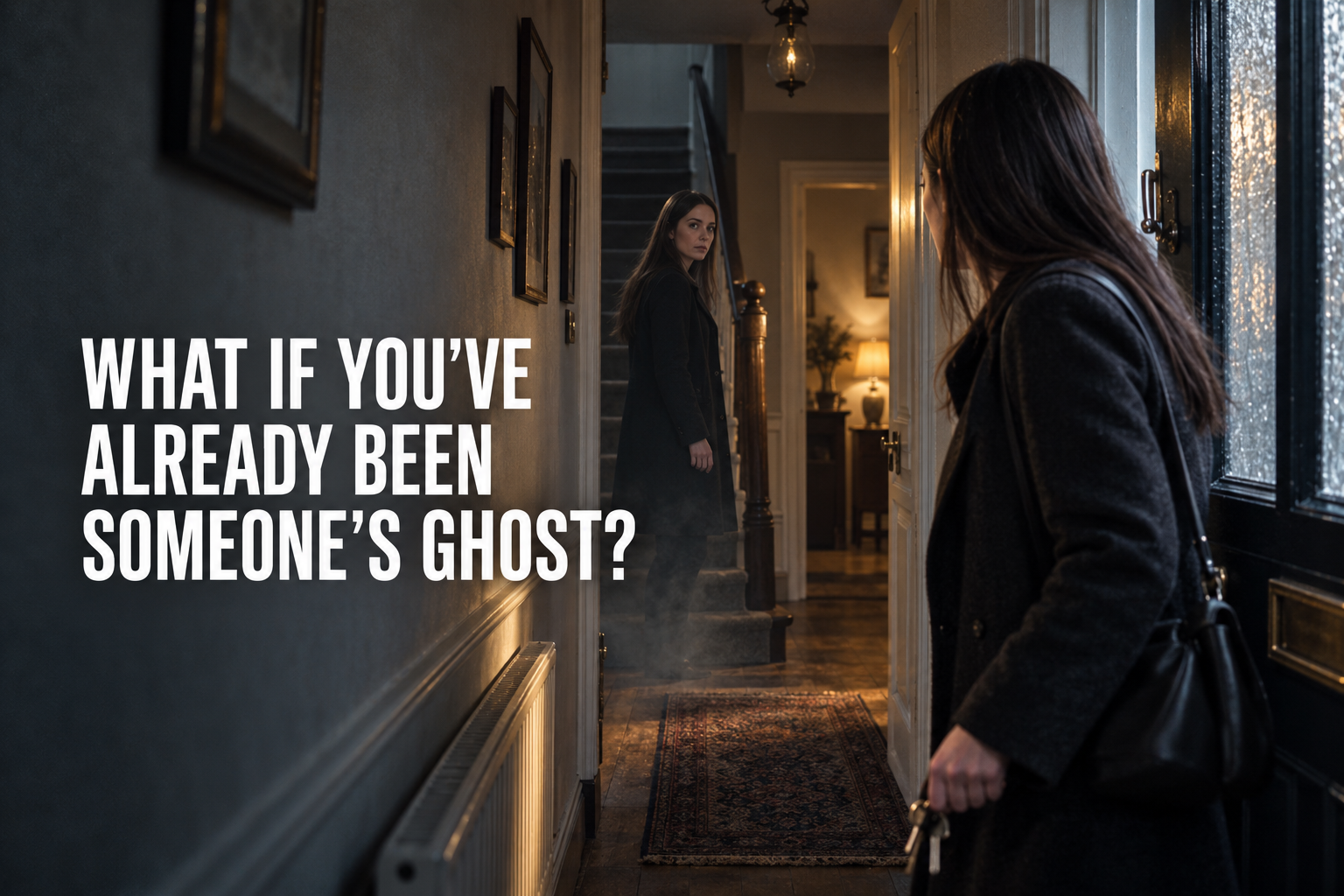
Imagine your partner insisting that you came home half an hour ago.
They heard the front door, your footsteps in the hall, the familiar sound of you putting your keys down. They called out. When you didn’t answer, they assumed you’d gone upstairs.
You’ve only just pulled up outside.
It’s an odd little scene to picture because there’s nothing particularly frightening in it until you compare accounts. Everything your partner heard belonged to an ordinary evening. The frightening part is that you weren’t in it.
Stories about apparitions of the living turn up in folklore and in the records of early psychical researchers. In these accounts, somebody can be seen far from where they actually are, with no idea that anyone has seen them at all.
The familiar types of hauntings don’t cover every strange experience.
The woman in the cabin
In October 1863, a passenger named Wilmot was crossing the Atlantic from Liverpool to New York. After days of stormy weather, he dreamed that his wife entered his cabin, hesitated at the doorway, then came over and kissed him.
His wife was in America.
According to Wilmot’s account, his cabin companion, a man named Tait, then remarked on the woman who had visited. Tait supposedly saw her while awake.
When Wilmot reached his wife, she asked whether he had received a visit from her. He said she described finding him aboard the ship, including the unusual arrangement of the bunks and the other man watching.
There’s a substantial catch. The account reached the Society for Psychical Research in 1889, more than twenty years later. Tait had died before investigators could question him. We have a remarkable story, but no opportunity to hear the crucial second witness’s version directly.
Still, consider the story on its own terms for a moment. The woman entering that cabin was alive. The apparent visitor was someone who might later ask how the crossing had been.
Arriving before yourself
Norwegian folklore has a name for a related idea: the vardøger.
This is a presence that announces someone before they arrive. It is usually heard, sometimes seen. Footsteps, a creaking door or even a recognisable cough suggest that a particular person is there, although they have yet to turn up.
Think about how little you need to hear to recognise someone you live with. You might know who’s coming up the stairs without looking. Put those same sounds in an empty house and the familiarity becomes the disturbing part.
In the folklore, the person eventually arrives. There need be no death to discover afterwards. You could tell them about it over dinner.
That gives the imagined conversation a peculiar awkwardness. How do you ask someone why they were walking around your house before they got there?
And then there’s the doppelgänger
We now use doppelgänger fairly casually for someone who looks remarkably like another person. The older folklore meaning is stranger: a ghostly double of somebody who is still alive. The word comes from the German for “double” and “goer”.
Picture seeing someone with your face standing at the top of your stairs. The same coat. The same way of holding their head. Close enough that, for a moment, you recognise yourself before you understand what you’re looking at.
Doppelgänger stories bring that fear into view. Someone else might encounter your double, or you might be the one who sees it. A vardøger’s early arrival and a ghostly double belong to different traditions, but both make room for a person to have an apparent presence beyond their physical whereabouts. Neither requires that person to have died.
Who said anyone had died?
The early psychical researchers took reports involving the living seriously enough to devote a major work to them. In 1886, Edmund Gurney, Frederic Myers and Frank Podmore published Phantasms of the Living, examining experiences they thought might involve communication between minds without the ordinary senses. Telepathy was their proposed explanation, not an established finding.
It leaves us with a useful problem when we investigate a haunting.
Suppose someone sees a woman standing on a landing. She disappears before they can speak to her. Nobody knows who she was.
At what point do we decide she must be dead?
The sighting itself hasn’t supplied that information. We might start searching the building’s history for a former resident who fits, but that search already assumes we know what sort of explanation we’re looking for. Find a vaguely suitable photograph and it becomes tempting to give the figure a name.
Now suppose the witness recognises that woman as a friend who lives two streets away. The friend is alive and says she was at home all evening.
The experience hasn’t become less strange. Yet the question has changed completely. We’d ask about a lookalike, a mistake, the light, whether the witness had been falling asleep. Someone might suggest a double or an experience like the Wilmot account. We would have to think beyond the history of the house.
Those ordinary possibilities deserve attention in either version. A familiar sound can be misidentified. A person can be mistaken about what they saw. And an account collected decades afterwards leaves plenty of room for details to shift. Naming an experience doesn’t settle its cause. Our guide to assessing a possible paranormal experience takes those checks further.
Even if we think a witness encountered something paranormal, we still have to explain why we’ve identified it as a dead person.
An unfamiliar face gives us very little to go on. We don’t know whether it belongs to someone buried a century ago, someone buying milk round the corner, or someone who exists only in the witness’s perception.
Imagine being on the other side of that uncertainty. You’ve had an unremarkable evening. Somewhere else, a person is trying to explain why they saw you standing in their doorway.
You would have no reason to think anything had happened.
Somebody could have a ghost story about you. You’d only find out if they recognised you.