
When the Notes Become Part of the Case
A KASE response to Houran, Lange, Massullo, O'Keeffe and Schumacher's paper on trickster-like experiences while documenting the paranormal.
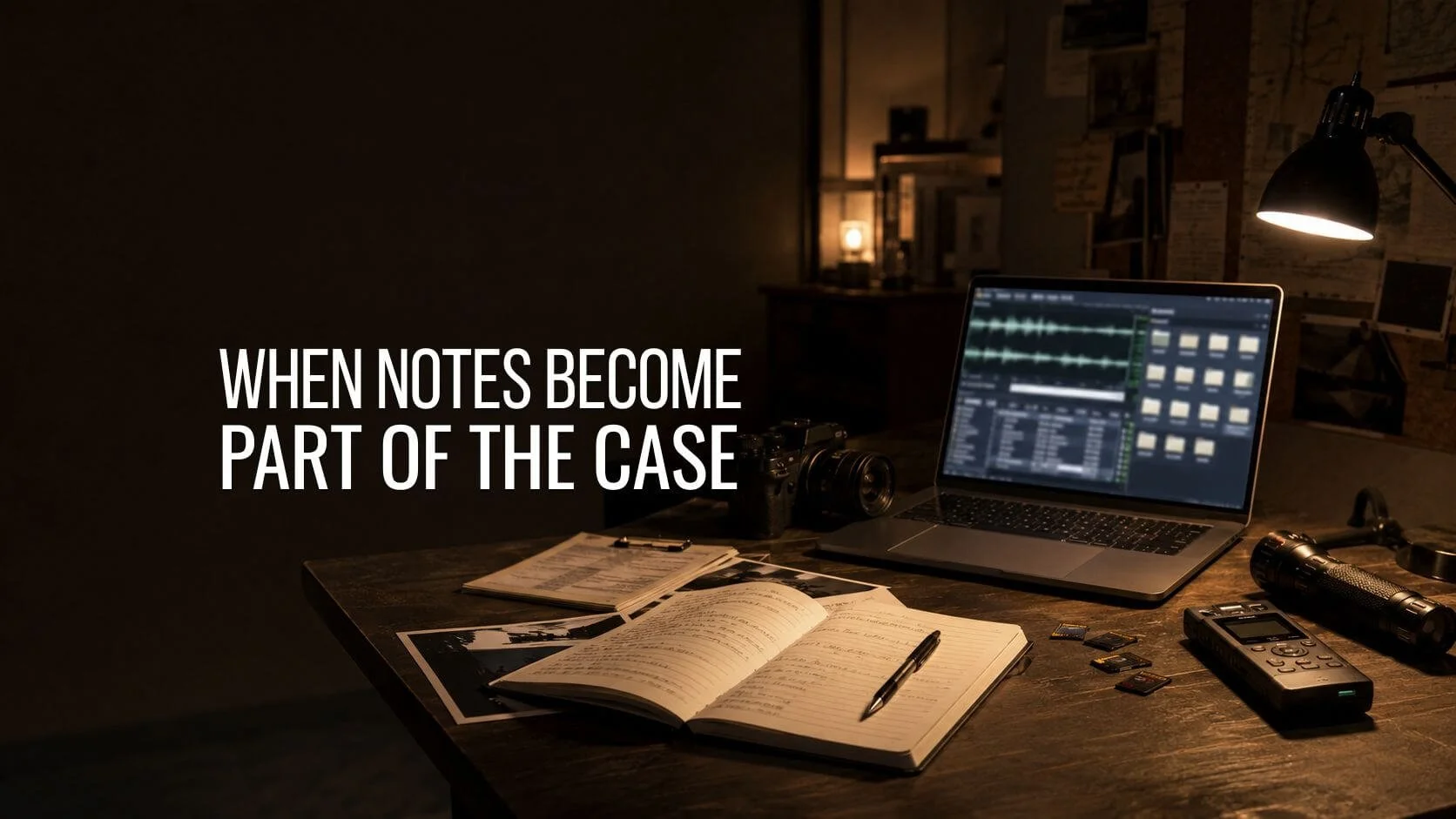
A paranormal investigation does not end when the team leaves the building.
In some ways that is where the harder part begins. The night itself is immediate: a sound is heard, a device reacts, a room changes atmosphere, someone feels watched. In the moment those things can feel sharp and convincing. But that is not yet evidence. Evidence comes later, when the team returns to the notes, checks the times, compares witness accounts, reviews audio and video, looks again at the equipment, and asks whether the strange thing is still strange once ordinary explanations have had their say.
A recent paper makes that point in a way we found hard to put down. KASE was tagged in Ciaran O'Keeffe's post on X, which pointed to a Journal of Scientific Exploration article by James Houran, Rense Lange, Brandon Massullo, Ciaran O'Keeffe and David Schumacher (2026, JSE 40(1), 52-74). It puts clear language to something investigators already know in their bones: the case often continues inside the documentation, and sometimes the strangeness seems to follow you home into the paperwork. You can see the same thing across our own case studies and blog posts whenever we reach the review stage.
What Is The Paper Actually About?
The paper opens with a small, genuinely odd problem the authors call a phantom citation. A statistic in one of their earlier reports was correct, but the reference attached to it was wrong, and none of the authors could work out how that wrong citation had got into the work. The fact was real. Its source was not. Their first thought was an AI hallucination, since large language models had been used to help check the original fact sheet, but that did not hold up. The bad reference did not come from the AI task, and nobody could recall ever adding it. For the record, the phantom source was a fabricated Watt, Wiseman and Tierney (2015) paper, later corrected.
From there the authors built an initial survey of 167 paranormal-oriented researchers, made up of 160 amateur investigators and 7 credentialed scientists, asking whether they had experienced anything unusual while writing up, analysing, or otherwise handling ghost-related material. They ran the results through Rasch analysis, a method for ordering items by how commonly they occur, and turned them into a first-draft measuring tool they call the Trickster-Like Experiences Inventory. The full PDF is worth reading directly, because the authors are more careful than any quick summary makes them sound.
The headline pattern is worth sitting with. Subjective experiences were the most common. Vivid or thematic dreams topped the list at around 30%, followed by meaningful coincidences and a strong pull or aversion to the material being written. Hard, objective events were rarer. Missing files, devices behaving strangely, and erratic computer behaviour sat at the bottom, the last at around 7%. Across the sample, subjective experiences ran about 1.6 times more often than objective ones. There was also a neat split between the two groups: the credentialed scientists mostly reported concrete things like missing files and altered text, while the amateur investigators reported a far broader, more subjective range.
That distinction matters. This is not a paper claiming that ghosts interfere with laptops, files, citations, or recordings. It also does not prove that trickster forces are objectively present during investigations. It is more careful and more interesting than that. It points at the instability of documentation itself, the way memory, expectation, emotion, devices, files, and interpretation can all quietly become part of the case.
The Trickster Chain
The most useful idea in the paper, and the one worth borrowing, is what the authors call a trickster chain. The argument runs like this. One small glitch, say a file that will not save, lifts your alertness and your expectation that something odd is going on. That heightened state primes you to notice the next small thing, and the next, and each one seems to confirm the story you have already started telling yourself. What feels from the inside like escalating activity may in fact be an ordinary feedback loop between attention, emotion, and mental load. The authors link this to the better-known hitchhiker or contagion effect, where activity reported at a location seems to follow people home afterwards. Whether the cause turns out to be psychological or something stranger, the practical lesson is the same: the chain is most dangerous to good evidence exactly when it feels most convincing.
What The Paper Does Not Claim
The authors themselves lean towards ordinary explanations, which is part of why the paper is worth taking seriously.
It does not prove that paranormal forces alter documents or equipment.
It does not turn every glitch, missing file, odd dream, or emotional shift into evidence.
It does not remove the need to check normal explanations first.
It does not give investigators permission to use “trickster” as a tidy label for anything confusing.
In fact the paper maps each reported anomaly onto a plain psychological mechanism: reconstructive memory, source-monitoring errors, mental load, priming, and the everyday habit of reading meaning into coincidence. The authors are clear that most of what they recorded is probably ordinary cognition working under pressure.
Where The Authors Stay Cautious
A serious response should give the paper's own caveats the same weight we would give to our own evidence. The authors flag that “trickster” is a slippery word that risks becoming a catch-all for anything unexplained. They note that a survey openly framed around trickster experiences may have attracted people already drawn to the idea, which can push the numbers up. And they accept that their single underlying statistical factor might simply be measuring the normal rate of human error rather than anything paranormal. None of that sinks the paper. It is what honest, early-stage research looks like, and it is the same discipline we try to apply when we say a case is unexplained rather than proven.
How Evidence Starts Misbehaving In Real Life
In real investigations, most evidence does not arrive as a clean fact. It arrives as a human experience that has to pass through several filters before it can be used responsibly.
Someone hears footsteps. Later, those footsteps become a timestamp. The timestamp becomes a clip. The clip becomes a discussion. The discussion becomes a line in a report. The line in the report may then become part of a location's wider story. At each stage, something can sharpen, drift, or become contaminated.
Common Places Evidence Can Shift
Memory: people remember the shape of an event, but not always the exact wording, order, or timing.
Audio review: ambiguous sounds can start to resemble words once a suggested phrase has been introduced.
Group discussion: one strong interpretation can quietly influence the way everyone else describes the event.
Technical handling: file names, storage locations, device settings, batteries, clocks, and autosave behaviour all matter.
Atmosphere: old buildings, darkness, fatigue, expectation, and emotional charge can make ordinary sensory information feel significant.
How It Often Feels
The awkward thing is that documentation problems do not always feel ordinary. A corrupted file, a missing note, a sound that appears in review but was not heard on the night, or a shared memory that will not quite line up can feel as strange as the original experience. That is exactly the kind of moment the trickster chain describes. It does not mean the problem is paranormal. It means the documentation has become part of the investigation, and that is the point where we slow down rather than speed up.
Ordinary Explanations And Paranormal Possibilities
Everyday Explanations Worth Considering
Checking ordinary explanations is not a dismissal. It is fairness. It protects the people involved, the location, and the evidence itself.
Fatigue, stress, and attention narrowing during long investigations.
Sound travel, echoes, pipes, heating systems, old floorboards, wind, traffic, aircraft, wildlife, and neighbouring buildings.
Device limits, low batteries, loose connections, sensor sensitivity, file corruption, and mismatched timestamps.
Confirmation bias, pattern seeking, suggestion, and the natural human desire to turn fragments into a coherent story.
Emotional atmosphere, especially in sites linked with trauma, isolation, conflict, death, or repeated public storytelling.
Paranormal And Spiritual Perspectives
At the same time, a grounded approach should not flatten every case into “just a creaky building”. Some events stay interesting precisely because the normal routes have been checked and the pattern still holds.
Here the paper offers a line we keep coming back to. Drawing on Kennedy's work, the authors argue that the trickster is best understood not as an outside spirit playing games, but as a mirror held up to the investigator's own biases, expectations, and blind spots. That fits how we work. The more useful question is rarely “was this paranormal?” on its own. The better questions are whether the event clusters with anything else, whether more than one witness reported it independently, whether it was captured by a locked-off recorder or camera, whether it repeats in the same area over time, whether the timing lines up with other notes, and whether it survives careful review. That is the careful middle ground. Not dismissive. Not gullible. Open to the genuinely strange, but disciplined enough to let weak evidence remain weak.
Real Cases And Examples
Our own case studies do not prove the paper, and we would not claim that they show trickster activity. They are useful as field comparisons because they show why documentation and interpretation matter.
Slough Fort - Patterns Only Matter After Review
Slough Fort is interesting because of repeat patterns across visits and areas: footsteps, responsive-style equipment behaviour, physical sensations, and the recurring “chase” dynamic in the lower magazine. None of that becomes strong because it feels dramatic on the night. It becomes useful only when the notes, areas, timings, team positions, static footage, and earlier visits are compared.
Fort Burgoyne - Testing Before Interpretation
At Fort Burgoyne, the laser grid break was important not because a light changed, but because the team attempted controlled testing afterwards. The case study records what happened, what was tested, and what remained unexplained rather than presenting the incident as proof. That is exactly the kind of discipline this discussion needs.
Kelvedon Hatch - The Recorder As A Witness, Not A Judge
Kelvedon Hatch gives a useful example of post-investigation review. A potential EVP captured on a locked-off camera is more interesting than a voice heard in a busy room, but it still has to be tested against team positions, sound travel, floor layout, visible movement, and environmental conditions. A recorder can be a witness. It is not a perfect witness.
Ashford And Old Havana - Why Caution Protects The Strange
The Ashford home paranormal investigation shows the value of ruling out heating noise, car doors, cold glass, candle flicker, and ordinary house movement before focusing on what remained unusual. The Old Havana / ATIK case study is different: the soap dispenser incident and other device behaviour were striking, but even there, the responsible response is not to leap to a conclusion. It is to ask better, duller questions about batteries, sensors, moisture, vibration, static cameras, and repeatability.
What To Do When The Evidence Becomes Unstable
First Steps Investigators Can Take
Keep a calm log of times, locations, people present, weather, equipment used, and obvious contamination risks.
Separate immediate notes from later interpretation. “Heard three knocks at 22:14” is different from “spirit responded”.
Review audio without giving listeners the suggested phrase first.
Check device clocks, batteries, settings, storage, and file names before treating a technical problem as meaningful.
Compare witness accounts before group discussion wherever possible.
When It Might Be Time To Slow Down
The more emotionally charged a case becomes, the more careful the documentation needs to be. This is the trickster chain in plain clothes. If a team starts feeling pushed, rushed, unsettled, unusually convinced, or unusually defensive, that is not the moment to make a bigger claim. It is the moment to pause, check the notes, and let the evidence breathe.
How KASE Paranormal Approaches Evidence
KASE is curious, but we are not interested in forcing a conclusion. Our approach is respectful, methodical, and evidence-aware. We consider ordinary explanations first because that is how we give the genuinely strange a fair chance to stand out.
That means we care about baselines, timestamps, witness comparison, environmental notes, equipment behaviour, static cameras, audio review, and honest language. We would rather say "unexplained at this stage" than dress uncertainty up as proof.
It is worth noting that the paper lands on the same habits from the other direction. The authors recommend systematic proofreading, independent cross-checks, and blinded controls where they are possible, which is academic language for the discipline above. When a peer-reviewed parapsychology team and a Kent investigation team arrive at the same checklist independently, that is a good sign it is worth keeping.
This is also why our paranormal investigations are structured around listening first, checking carefully, and giving clear feedback. Sometimes the answer is practical. Sometimes the answer remains open. Either way, the person or place deserves better than theatre.
Thinking About A Paranormal Investigation In Kent Or The South East?
You do not need dramatic, TV-style evidence to ask for help. Many conversations start with something simple: “I feel uncomfortable in my own home and I just want to know whether there is anything to this.”
A structured paranormal investigation can help when:
You have done basic checks and things still do not feel right.
Multiple people have had similar experiences in the same rooms.
The activity affects sleep, routine, or your willingness to use certain parts of the house.
You want a neutral, respectful team to look at the situation with fresh eyes.
KASE Paranormal offers home paranormal investigations across Kent and the wider South East. You can read more about how that works here: Paranormal Investigations.
If you would like to reach out, you can:
Use our contact form to outline what you are experiencing in your own words.
Request a free chat about what you are experiencing directly in the contact form.
Reach us via email or WhatsApp if you would like to get in touch quickly.
You can also browse other articles on our KASE blog if you want to read more while you decide what to do next.
Whether your house turns out to be haunted, quirky, or simply in need of a few repairs, you deserve to feel safe and settled in your own space. If something does not feel right, it is completely reasonable to ask for help.